
Gas Ramps or How to Make Working with Cylinders Convenient and Safe.
Gas cylinders are widely used both in household and various industrial sectors. The modern market offers equipment to make working with cylinders more convenient and safer. The most common of these is gas ramps.
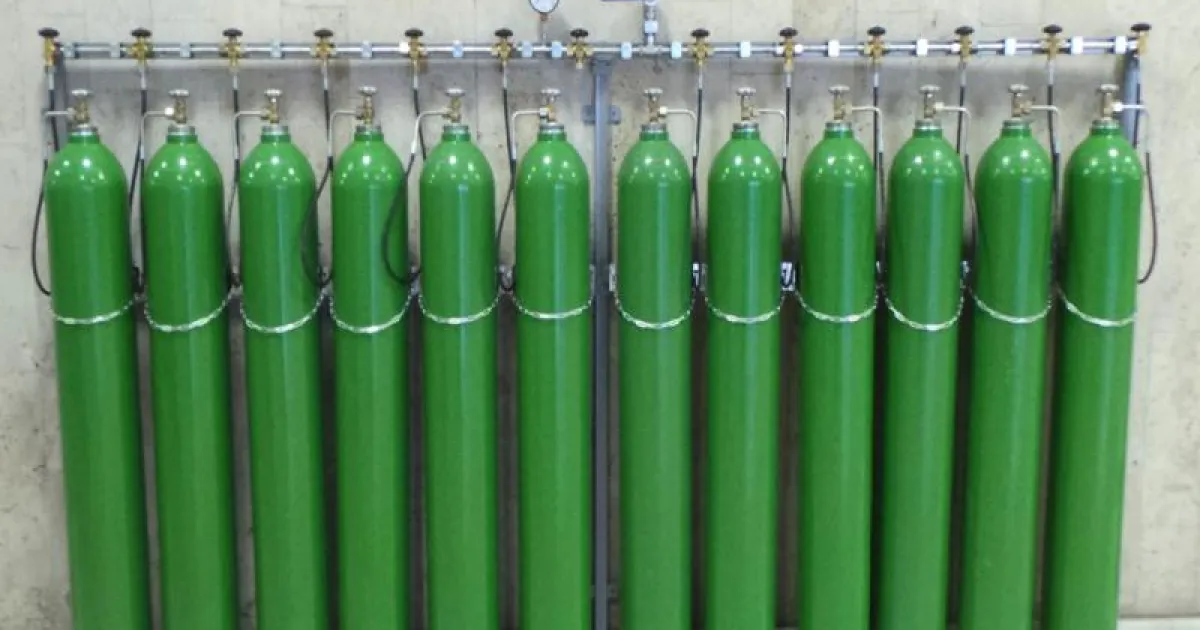
For convenient work with cylinders
Gas cylinders are widely used both in household and various industrial sectors. The modern market offers equipment to make working with cylinders more convenient and safer. The most common of these — gas ramps.

A gas ramp allows connecting multiple gas cylinders to the consumption line at once. This has its advantages: it increases the interval between refills, and cylinders are protected from freezing in case of high gas consumption.
Each gas cylinder is connected to the ramp individually, which allows using all cylinders simultaneously or part of them, as desired.
Gas ramps consist of piping systems and shut-off valves, and come in three types:
— filling,
— transfer,
— discharge.
Filling
Using filling ramps, gas cylinders are refilled from any source:
— air separation units,
— high-pressure gasification units,
— gasifiers,
— compressors.
The design of such ramps allows continuously filling cylinders with technical gases (nitrogen, argon, oxygen, air) up to 20 MPa (approximately 200 atmospheres).
A filling ramp consists of one or two branches (collectors), a connection node, pressure gauges, gas supply valves, and a safety valve. Each collector can be connected to 2 to 10 cylinders or more, as desired by the customer.
Transfer
These ramps perform the reverse function: they deliver gas from cylinders to consumers. This is typically associated with large volumes of consumption.
To ensure continuous supply of technical gases to production, the market offers a wide range of transfer ramps from cylinders with initial pressure up to 20 MPa.
A transfer ramp is equipped with a reducer, designed to lower the gas pressure to working levels and maintain it constant. This is important for centralized gas supply to gas welding posts during gas-flame processing: welding, cutting, soldering, thermal spraying.
Discharge
These ramps differ from transfer ramps only in the pressure they can maintain and, accordingly, their capacity. Discharge ramps are typically used in laboratories to supply technical gases to equipment. Gas is supplied to the discharge ramp from cylinders at standard pressure up to 20 MPa, and then delivered to production through a reducer in small quantities.
All ramps can be installed either indoors or outdoors: against factory walls in a special cabinet or under a canopy. But usually they are mounted on the walls of buildings.
The company "Dioksid" produces both standard and custom-made ramps, refills gas cylinders with nitrogen, argon, carbon dioxide, food-grade and welding gas mixtures, including refilling oxygen cylinders http://dioksid.ru/tekhnicheskie-gazy/gazy-v-ballonakh-kriotsilindrakh/kislorod from 140 rub./5L. If needed, gas ramps can be purchased on lease. The company "Dioksid" has a service center, repair teams can be dispatched to any location in Russia.
Editorial team agronom.info
Materials are prepared by the portal's agronomists and editors. We use only trusted sources: Ukrainian agricultural universities, variety registries, open scientific publications.
Related articles

LSTC Hangars: A Modern Solution for Rapidly Erected Buildings

Estimate 2026: How much does a complete turnkey roof replacement for a private house really cost?
Comments · 0