
Buying Seeds
Seedlings are the foundation of future harvests, so experienced gardeners pay close attention to the selection, delivery, and storage of such products. Before buying vegetable seeds, it is necessary to carefully plan the planting parameters.
Seedlings are the foundation of future harvests, so experienced gardeners pay close attention to the selection, delivery, and storage of such products. Before buying vegetable seeds, it is necessary to carefully plan the planting parameters. For the middle zone, the optimal planting season is from mid-February until the end of March. Some gardeners purchase planting material for several seasons at once. To prevent seeds from spoiling, it is necessary to maintain an appropriate temperature regime and optimal humidity levels. Storage conditions are usually indicated by seed manufacturers on the packaging, so it is advisable to follow the provided recommendations.
Growing vegetables in open ground or greenhouse conditions requires careful preparation not only of the planting material but also of the soil itself. A planned harvest cannot be achieved if seed planting is carried out with serious errors. After finding quality planting materials for growing vegetables in different seasons, it is necessary to listen to the reviews of local buyers. Upon discovering a wide variety of seeds, some gardeners buy everything indiscriminately. This is one of the main mistakes made by beginners who unconditionally trust the image on the packaging, ignoring the study of seed descriptions.
Regardless of whether you need to purchase hybrid vegetable seeds or traditional planting materials, planting will primarily depend on local climatic conditions, irrigation parameters, and soil preparation quality. Otherwise, the gardener will encounter numerous problems at all stages of plant cultivation, from planting to harvest.
The supplier offers, along with traditional seeds, interesting hybrid and modified plants. There is a common misconception that hybrids are genetically modified products (GMOs). In reality, hybrid vegetables are obtained through selection, quality control, and crossing parent varieties. The main difference from regular planting material is the ability to obtain more resilient products. Hybrids are less susceptible to sharp temperature fluctuations, sudden changes in soil moisture levels, and other adverse environmental factors. Moreover, they provide better yields and superior fruits.
Editorial team agronom.info
Materials are prepared by the portal's agronomists and editors. We use only trusted sources: Ukrainian agricultural universities, variety registries, open scientific publications.
Related articles
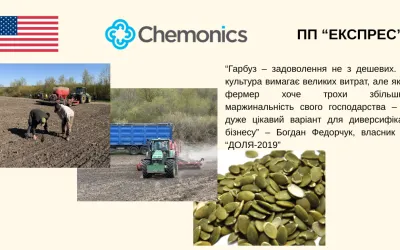
From scratch to its own brand: How DOLYA-2019 Farm is building a niche agribusiness on pumpkin seeds
Comments · 0