Small swine's succory
Arnoseris minima (L.) Schweigg. & Körte
Description
Small swine's succory (Arnoseris minima) is an annual herbaceous plant belonging to the Asteraceae family. In agricultural practices, it is identified as a field weed that occasionally competes with cultivated crops in light, nutrient-poor soil conditions across its native European range.
The plant is typically found in habitats characterized by acidic, sandy soils. It is well-adapted to environments where competitive pressure from other vigorous species is low. Because of its specific soil requirements, its presence often serves as an ecological indicator for low pH levels within a field.
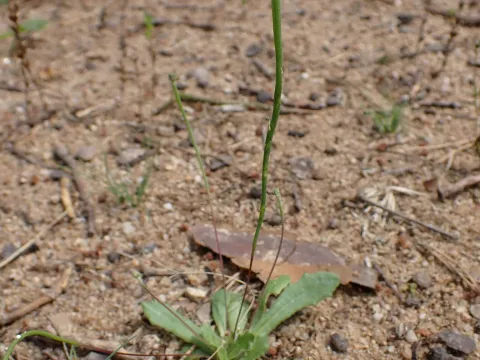
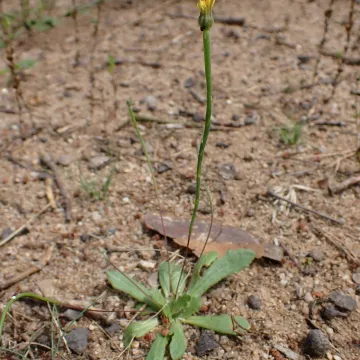
Botanically, the plant features a basal rosette of oblong, toothed leaves. It produces thin, branched stems that bear small yellow flower heads. These flower heads are distinct in their structure and contribute to the plant's ability to produce large quantities of seeds, ensuring its survival even after heavy agricultural interventions.
Agrotechnical management of this species primarily involves soil amendment techniques such as liming, which increases the pH and renders the habitat unsuitable for the species. Furthermore, effective crop rotation and standard pre-emergence mechanical weeding are essential to prevent the establishment of dense populations in cereals and other field crops.
While the economic impact is usually minor, the plant serves as a host for various pests and fungal diseases common to the Asteraceae family. For instance, it can harbor powdery mildew, which under favorable conditions may spread to nearby crops. Therefore, controlling this plant is recommended to maintain optimal field hygiene and prevent the escalation of plant diseases.
Photo gallery