Goldentuft alyssum
Aurinia saxatilis (L.) Desv.
Description
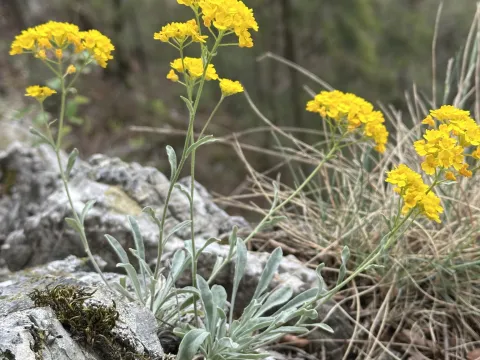
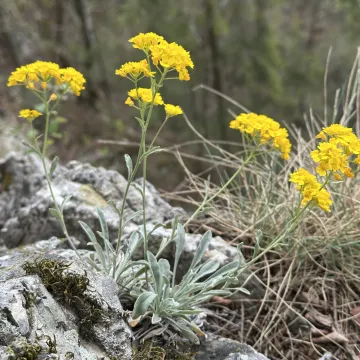
Goldentuft alyssum (Aurinia saxatilis) is a prominent perennial subshrub belonging to the Brassicaceae family. Highly valued by gardeners for its spectacular early spring display, it produces dense clusters of bright yellow flowers that create a vibrant visual impact, often completely masking the foliage underneath.
Originating from the mountainous regions of Central and Southern Europe, this species has evolved to thrive in harsh, rocky environments. Its natural habitat includes limestone cliffs and stony slopes, which has influenced its high tolerance for poor, infertile soils and intermittent drought conditions. It is a classic plant for rock gardens and xeriscaping.
Botanically, the plant forms a woody-based mound reaching up to 40 cm in height. Its leaves are lanceolate, slightly gray-green, and densely covered with fine hairs, which help the plant retain moisture. The four-petaled flowers bloom in terminal racemes, offering a sweet fragrance that attracts early pollinators to the garden.
In terms of agronomy, Aurinia saxatilis requires full sun exposure and well-draining, slightly alkaline soil. Heavy clay soils that retain moisture during winter are detrimental, as they often lead to root rot. Providing excellent drainage through gravel or sand amendments is essential for longevity and plant health in commercial or residential landscape settings.
Cultural practices include cutting back the flower stems after the primary blooming phase, which prevents the plant from becoming leggy and promotes a more compact growth habit. Common pests include flea beetles, which can damage foliage early in the season. Disease management focuses primarily on ensuring air circulation and avoiding overhead irrigation, which minimizes the risk of fungal infections such as powdery mildew.
- Full sun requirements for optimal flowering.
- Well-drained soil is non-negotiable.
- Propagate via seeds or semi-ripe stem cuttings.
- Minimal fertilization needed; too much nitrogen causes weak growth.
- Hardy to most temperate climate zones.
Photo gallery