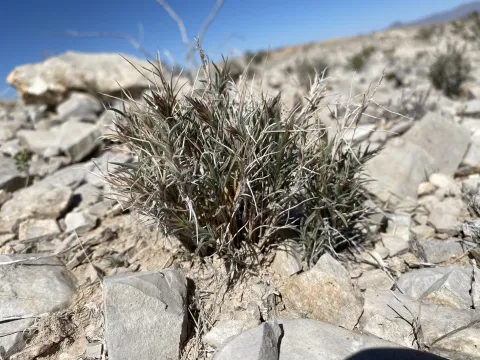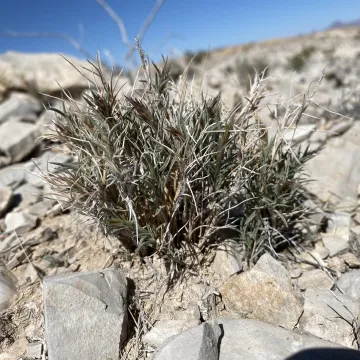
Blepharidachne bigelovii
Blepharidachne bigelovii
Description
Blepharidachne bigelovii is a perennial grass species belonging to the Poaceae family. Commonly known as Bigelow's desertgrass, this plant is specifically adapted to survive in harsh, arid, and semi-arid environments where water availability is chronically limited.
The plant is native to the southwestern United States and northern Mexico. It typically occupies ecological niches in desert scrublands, rocky hillsides, and limestone-based soils. Its presence in these regions serves as a vital component of the local ecosystem, providing stabilization for fragile soil surfaces.
Botanically, it is distinguished by its compact, low-growing tufted growth habit. The leaves are typically narrow, stiff, and often involute, an adaptation that significantly reduces water loss through transpiration. The inflorescence is a dense, hairy panicle that provides the plant with its characteristic appearance.
Agrotechnical management of this species focuses on maintaining excellent soil drainage. It thrives in poor, rocky soils and requires full sun exposure. Growers must avoid over-irrigation, as root rot is the primary physiological threat when the plant is kept in saturated soil conditions for extended periods.
Currently, the usage of this grass is largely focused on ecological restoration and rangeland conservation. It serves as a study model for drought tolerance in grasses. Potential future applications include its use in sustainable landscaping in arid climates and as a forage component in extremely dry grazing systems.
- Extreme drought resistance.
- High tolerance for mineral-rich, shallow soils.
- Limited biomass production compared to forage-specialized grasses.
Photo gallery