Blumea balsamifera
Blumea balsamifera (L.) DC.
Description
Blumea balsamifera (L.) DC. is a perennial herb or subshrub belonging to the Asteraceae family. Known primarily as the source of Ngai camphor, this crop is valued globally in the pharmaceutical and fragrance industries for its unique essential oil profile, which is dominated by borneol.
The plant originates from Southeast Asia and is widely cultivated across tropical regions, including Malaysia, Indonesia, the Philippines, Thailand, and Southern China. It thrives in open fields and forest fringes, requiring specific climatic conditions marked by high humidity and consistent tropical temperatures throughout the year.
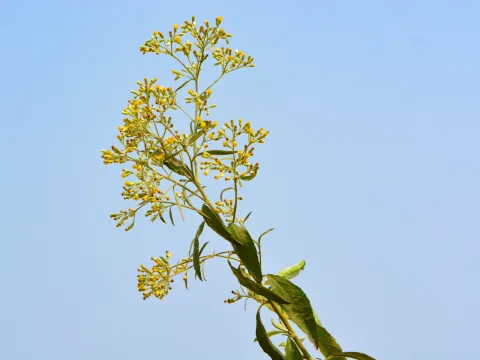
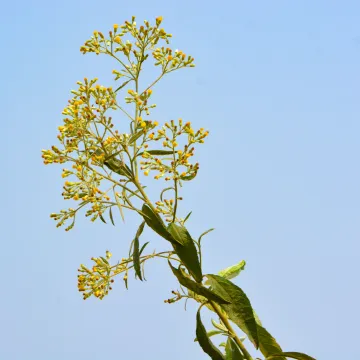
Botanically, it is a sturdy, upright plant reaching heights of up to 3 meters. The leaves are distinctively shaped, elongated with serrated margins and a tomentose (woolly) texture on the undersurface. Its inflorescences consist of dense yellow flower heads arranged in terminal panicles, which significantly contribute to the plant's overall biomass production.
Agronomic requirements for successful cultivation include well-drained, nutrient-rich soils with good moisture-retention capacity. The plant is highly responsive to organic fertilization and requires a consistent irrigation schedule to maintain peak leaf production. Propagation is most efficiently achieved through stem cuttings, which ensure genetic consistency and faster crop establishment.
The primary economic use of Blumea balsamifera lies in the extraction of essential oils and crystalline camphor for medical use. Its anti-inflammatory, antimicrobial, and insect-repellent properties make it a staple in traditional medicine and modern bioproduct manufacturing. In commercial farming, it is considered a high-value industrial crop due to the increasing demand for natural botanical extracts.
- Excellent potential for high biomass yield.
- Naturally resistant to many common agricultural pests.
- Key source of natural borneol and camphor.
- Suitable for sustainable and organic cultivation practices.
Photo gallery