Borage
Borago officinalis L.
Description
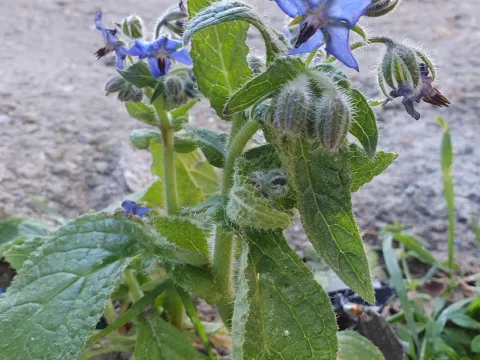
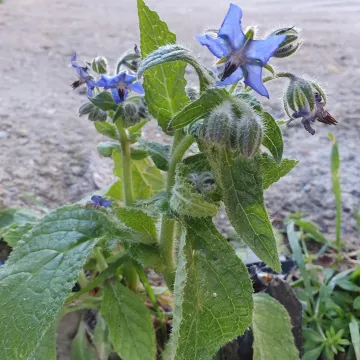
Borage, scientifically known as Borago officinalis L., is an annual herb that belongs to the Boraginaceae family. It is widely recognized for its edible, cucumber-scented leaves and distinct star-shaped, bright blue flowers that make it a favorite in both herb gardens and culinary applications.
Native to the Mediterranean region, borage has been naturalized across Europe, North Africa, and North America. It is extensively cultivated today for its commercial value as a source of gamma-linolenic acid (GLA), as well as for its use as a culinary herb and a high-quality honey-producing plant.
Botanically, borage is a robust plant that can grow up to 60–100 cm in height. Its stems and foliage are covered with stiff, prickly white hairs. The leaves are alternate and lance-shaped, while the flowers are arranged in nodding racemes, characterized by five triangular petals.
Borage thrives in full sun but can tolerate partial shade. It prefers well-drained, fertile soil with a slightly alkaline to neutral pH. As a resilient plant, it is easy to grow from seeds sown directly into the soil in early spring. It requires moderate watering and prefers not to be transplanted due to its deep taproot system.
The plant has diverse economic and practical uses. In the kitchen, young leaves are used in salads, soups, and beverages for their fresh, cooling flavor. Medicinally, borage oil is prized for its anti-inflammatory properties. Furthermore, borage is an exceptional pollinator attractant, making it highly beneficial for vegetable gardens.
- Excellent source of pollinators
- Edible leaves and flowers
- High cold tolerance
- Rich in essential fatty acids
- Easy to cultivate from seeds
Borage is generally hardy, but it is susceptible to powdery mildew, particularly in humid and crowded planting conditions. Pests such as aphids may occasionally attack the plant, but the coarse, hairy surface of the foliage generally acts as a deterrent for many common garden insects.
Photo gallery