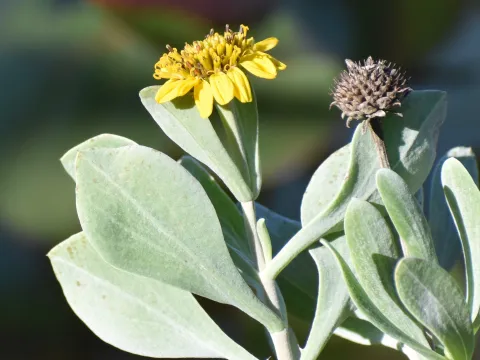
Borrichia frutescens
Borrichia frutescens
Description
Borrichia frutescens, commonly known as sea oxeye, is a perennial evergreen subshrub belonging to the Asteraceae family. In agricultural and ecological terms, this plant is classified as a halophyte, which means it is uniquely adapted to thrive in saline substrates that would be toxic to most conventional crops.
The plant originates from the coastal regions of North America, stretching across the Atlantic coast of the United States, Mexico, and the Caribbean. Its natural habitat includes salt marshes, tidal zones, and sandy dunes, where it plays a critical role in stabilizing coastal ecosystems against tide-driven erosion.
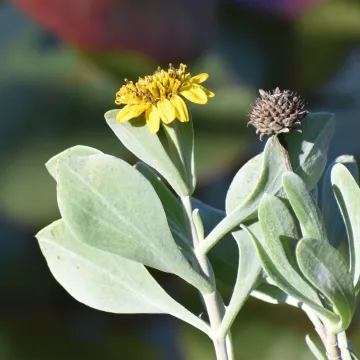
Botanically, Borrichia frutescens is distinguished by its leathery, opposite, grayish-green leaves, which are often covered in fine hairs to prevent water loss. The stems are woody at the base, reaching heights of 60 to 90 centimeters. The plant produces vibrant yellow, daisy-like flower heads that typically bloom from late spring through summer, providing a source of nectar for pollinators.
From an agrotechnical perspective, this species requires full sun exposure and well-draining soil. It is highly drought-tolerant and thrives in sandy or silty soils with high salinity levels. Unlike conventional crops, it does not require fertilizers or freshwater irrigation, making it an extremely low-maintenance plant suitable for challenging seaside conditions.
Key хозяйственное uses of the plant focus on environmental management:
- Stabilization of shoreline soil to prevent coastal erosion.
- Phytoremediation of salt-affected lands.
- Decorative use in xeriscaping and seaside landscape design.
- Conservation of biodiversity in coastal habitats.
Regarding pests and diseases, the plant is remarkably hardy. It is seldom bothered by traditional agricultural pests, though excessive humidity in stagnant freshwater conditions can lead to fungal issues. Due to its natural resistance and minimal maintenance requirements, it remains an excellent choice for environmental projects in maritime regions.
Photo gallery