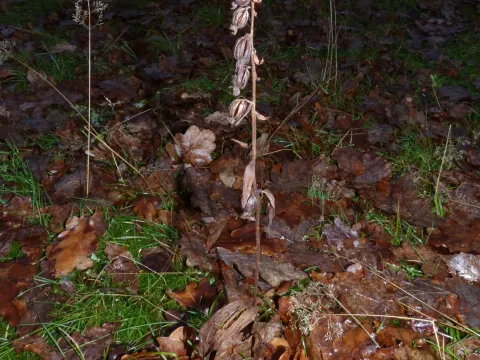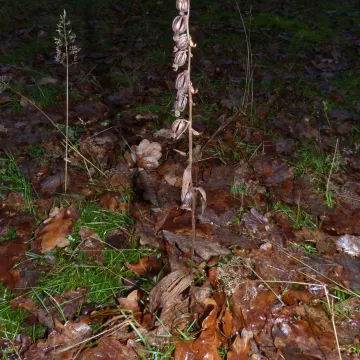

Broad-leaved helleborine
Epipactis helleborine (L.) Crantz
Description
The Broad-leaved helleborine (Epipactis helleborine) is a perennial herbaceous plant belonging to the Orchidaceae family. While not a conventional crop in modern industrial agriculture, it is a significant species in ethnobotanical studies, pharmacology, and specialty ornamental horticulture due to its complex reproductive biology.
Its native range extends across Europe, temperate Asia, and parts of North Africa, with established populations now also found in North America. This plant is highly adaptable, naturally occurring in deciduous forests, scrublands, and occasionally along the edges of agricultural plots, demonstrating a robust ability to colonize varied soil types.
Botanically, it features a stout stem that can grow up to 80 centimeters tall, adorned with broad, alternate, ovate leaves. Its underground structure, a short rhizome, is heavily dependent on specific mycorrhizal fungi to obtain nutrients, which is a hallmark of the Orchidaceae family and a primary challenge in its propagation.
Regarding cultivation requirements, this plant thrives in semi-shaded environments with well-drained, humus-rich soil that is neutral to slightly alkaline. Unlike standard crops, its agrotechnology focuses on maintaining soil microbiome health rather than heavy fertilization. Successful cultivation requires mimicking the natural forest floor conditions to protect the symbiotic fungi essential for root health.
The plant has historic applications in herbal medicine and provides high aesthetic value for specialized orchid gardens. The most common challenges in its maintenance include:
- Susceptibility to fungal root pathogens in waterlogged soils.
- Herbivory by slugs and snails.
- Need for specific pollinators for successful seed production.
Photo gallery