Madrid brome
Bromus madritensis
Description
Madrid brome (Bromus madritensis) is an annual grass species belonging to the Poaceae family. Recognized for its rapid growth cycle, this plant often thrives in disturbed environments, making it a subject of significant interest in agronomy for both its potential as an early-season forage and its role as a competitive weed in agricultural systems.
Originally native to the Mediterranean region, the species has successfully naturalized across various continents, including Europe, North Africa, and parts of Asia and the Americas. It is typically found in arid to semi-arid climates, favoring open landscapes, roadsides, and cultivated fields where it can capitalize on early-season moisture before the onset of extreme summer heat.
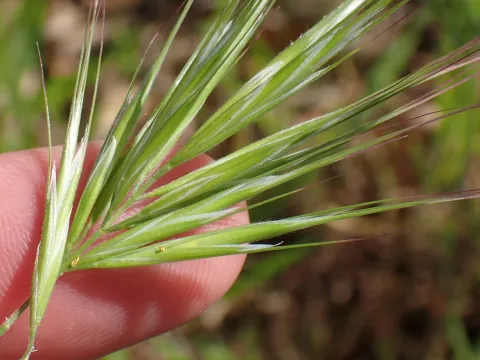
The botanical structure of the plant features slender stems, linear leaves with pubescent surfaces, and distinct panicle inflorescences. The spikelets are characterized by long awns, which facilitate seed dispersal through attachment to animal fur or movement by wind. Its growth architecture allows it to maximize resource uptake in nutrient-poor or compacted soils.
Regarding climate and soil, Madrid brome exhibits high ecological plasticity. It prefers well-drained soils and shows remarkable drought tolerance. Effective management in agricultural settings requires a combination of cultural practices, such as crop rotation, and timely tillage to prevent seed bank establishment. Herbicide applications are typically effective during the seedling stage.
- Rapid phenological development
- High competitive ability in winter crops
- Tolerance to nutrient-poor soils
- Susceptibility to rust fungi
- Potential injury to livestock due to sharp awns
In terms of economic utility, while it can provide limited grazing potential, the presence of stiff awns at maturity can pose risks to livestock health, potentially causing oral irritation. Furthermore, the species acts as an alternative host for various crop pathogens, requiring integrated pest management strategies to mitigate its impact on main cereal productions.
Photo gallery