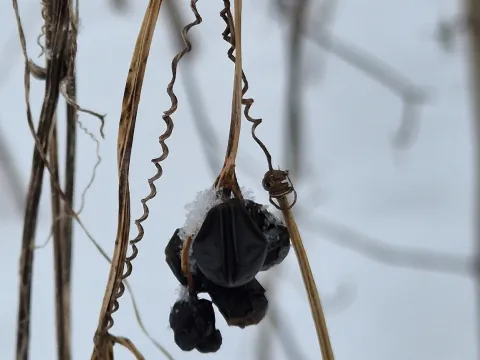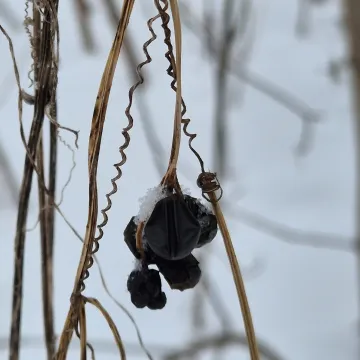

White bryony
Bryonia alba L.
Description
White bryony (Bryonia alba L.) is a perennial climbing plant belonging to the Cucurbitaceae family. It is characterized by a thick, fleshy root system that mimics a taproot and vigorous vining stems that utilize tendrils to climb surrounding vegetation or specialized supports, making it a distinct member of the gourd family.
Native to Central and Southern Europe and parts of Western Asia, this species has adapted to a wide range of habitats. In agricultural contexts, it is noted for its hardiness and ability to thrive in various soil types, provided there is adequate drainage. It often occupies edges of woods, shrublands, and disturbed ground where it can find vertical structures to colonize.
Botanically, the plant features alternate, palmately lobed leaves and small, greenish-yellow flowers. It produces dark black, globular berries which are notoriously toxic to humans and livestock. The rootstock is long-lived and can survive significant environmental stress, including frost, due to its deep penetration into the soil profile, which allows it to reach stable moisture and nutrient levels.
The cultivation of White bryony requires careful planning regarding space, as the plant grows rapidly during the season. Essential agrotechnical practices include the installation of robust trellising systems to promote airflow and prevent the accumulation of moisture on the foliage, which reduces the incidence of common diseases like powdery mildew. Regular pruning may be necessary to manage its expansion and prevent the plant from becoming invasive.
Economically, White bryony is primarily valued for its applications in homeopathy and traditional medicine, where extracts from the root are used to manage inflammation and pain. Furthermore, it serves as a decorative plant in landscaping for covering screens and walls. When handling the plant, it is imperative to wear protective gear, as the sap can cause skin irritation, and the entire plant contains compounds that are toxic if ingested.
- Perennial climbing habit
- Frost-hardy roots
- Medicinal value
- Requires trellis support
- Toxic berries
Photo gallery