Big sandreed
Calamovilfa gigantea
Description
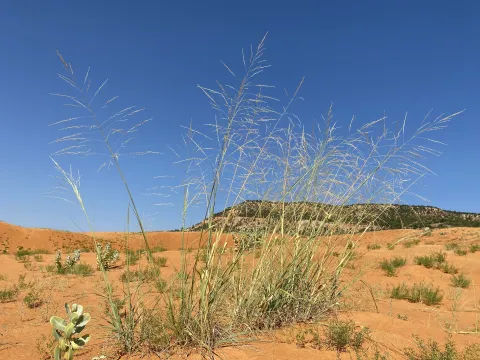
Big sandreed (Calamovilfa gigantea) is a robust perennial grass species belonging to the Poaceae family. This plant is widely recognized for its exceptional resilience and its crucial role in stabilizing sandy environments, making it a valuable asset for environmental conservation and agricultural land management.
Native to the central regions of North America, particularly the Great Plains, Big sandreed has evolved to thrive in harsh, arid landscapes. It naturally occupies sand dunes and sandy river valleys. Its introduction into managed agricultural systems is primarily focused on areas where severe wind erosion poses a threat to soil integrity and crop land stability.
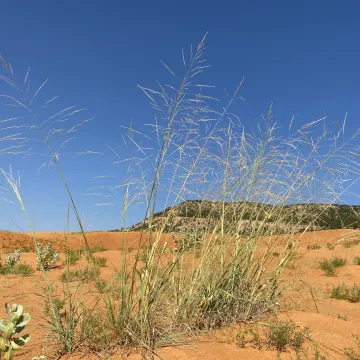
The botanical structure of this grass is defined by its extensive, deep-reaching root system, which can penetrate several meters into the soil. The stems are tall, sturdy, and can reach up to 2 meters in height, topped with large, plume-like panicles. The leaves are coarse and tough, a physiological adaptation that prevents water loss in high-temperature environments, ensuring survival during extreme droughts.
Agricultural requirements for Calamovilfa gigantea are centered on its need for well-drained, sandy substrates. It does not tolerate waterlogging or heavy, compacted clay soils. Once established, the plant is largely self-sustaining. The main management task involves preventing excessive spread and selecting appropriate planting sites that match its ecological preferences for dry and loose soil conditions.
Economically, the primary use of Big sandreed is soil stabilization and erosion prevention in disturbed landscapes. While it serves as forage for livestock in some arid rangelands, it is not typically grown for high-yield fodder due to its coarse texture. It is also used in restoration ecology to reclaim degraded land. The plant is notably hardy and shows high resistance to common fungal and viral diseases that typically affect conventional cereal crops.
- Superior stabilization of shifting sands and dunes.
- High drought and heat tolerance.
- Low-maintenance requirements for soil nutrients.
- Resistance to major agricultural pests and diseases.
Photo gallery