
California poppy
Eschscholzia californica Cham.
Description
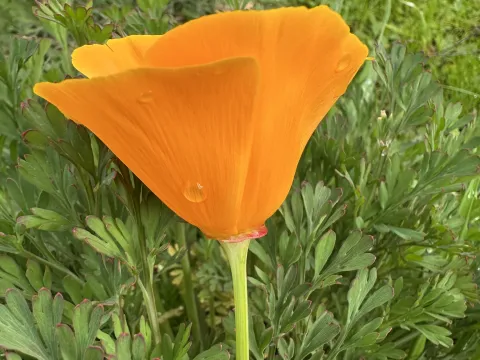
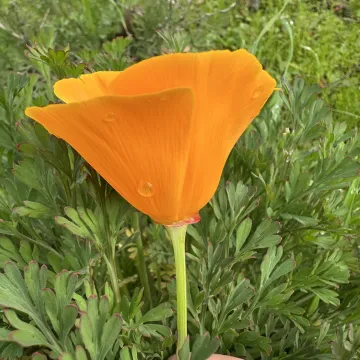
California poppy (Eschscholzia californica) is a herbaceous annual plant belonging to the Papaveraceae family. Recognized for its vibrant colors and delicate, fern-like blue-green foliage, it is a staple in many garden designs. The plant is celebrated for its ability to thrive in poor soil conditions and its high tolerance for drought.
Originating from the Western United States and Mexico, the plant has a historical range that thrives in Mediterranean-type climates. Its adaptation to rocky, dry landscapes makes it an excellent choice for xeriscaping or areas where water resources are limited. It has become a widely cultivated ornamental species in Europe, Australia, and various other regions with temperate climates.
Botanically, it features a deep taproot, which makes the plant highly resistant to drought but sensitive to transplanting. The flowers are cup-shaped, consisting of four silky petals that typically range in color from brilliant golden yellow and orange to red. These flowers are phototropic, meaning they close during overcast or night hours to protect their reproductive structures.
In terms of agricultural requirements, the California poppy demands full sun and well-draining soil. It prefers sandy or gritty substrates rather than rich, heavy loam, as high soil fertility often leads to excessive leaf growth rather than prolific flowering. Direct sowing is the preferred method of cultivation as it avoids root disturbance and encourages faster establishment.
Beyond its ornamental use, the California poppy is utilized for its mild sedative and analgesic properties in traditional medicine. When cultivated, it requires minimal maintenance, though it may be susceptible to aphids or powdery mildew if the planting site lacks proper air circulation. Regular removal of spent blooms can prolong the flowering season significantly, ensuring a vibrant garden throughout the warmer months.
Photo gallery