
Canotia holacantha
Canotia holacantha
Description
Canotia holacantha, commonly known as the crucifix thorn, is a distinctive woody shrub belonging to the Celastraceae family. This species is highly valued for its extreme drought tolerance and unique structural appearance, making it a specialized subject in both botanical research and dry-climate landscaping.
The plant is native to the southwestern United States and northwestern Mexico, particularly thriving in the arid environments of Arizona. It typically inhabits rocky slopes, desert scrublands, and alluvial plains, demonstrating a remarkable ability to extract moisture from nutrient-poor, dry soil in regions where annual rainfall is severely limited.
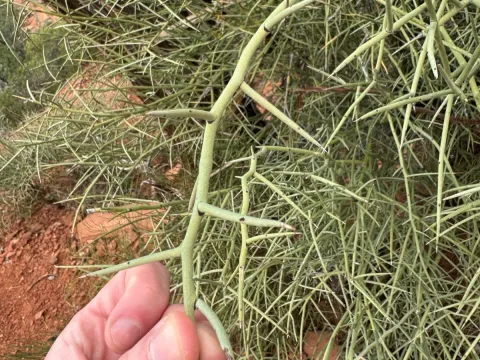
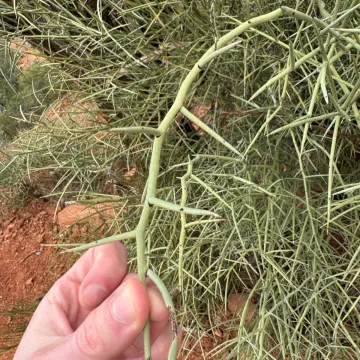
Botanically, Canotia holacantha is characterized by its reduced, deciduous leaves and green, photosynthetic branches that are tipped with sharp thorns. Growing as a small tree or large shrub, it can reach heights of up to 5 meters. Its physiological structure is a textbook example of desert adaptation, allowing the plant to minimize water loss through transpiration while maintaining energy production via stem tissue.
Regarding agricultural or horticultural requirements, this species demands excellent drainage and full sun exposure. It is not suitable for rich, clay-heavy soils that retain moisture for long periods. Once established, the crucifix thorn is virtually maintenance-free, requiring no irrigation, fertilizers, or pruning, making it an excellent candidate for xeriscaping projects where conservation of resources is paramount.
The primary use of Canotia holacantha is as an ornamental specimen in desert gardens or xeriscapes. While it is naturally robust, growers should monitor for the following conditions:
- Root rot caused by poor soil drainage.
- Infestations of sap-sucking insects during unusually wet seasons.
- Fungal pathogens triggered by high humidity levels.
Photo gallery