Asarum-leaved bittercress
Cardamine asarifolia
Description
Asarum-leaved bittercress (Cardamine asarifolia) is a herbaceous perennial member of the Brassicaceae family. It is prized in ornamental horticulture for its neat habit, unique foliage, and its ability to thrive in shaded, moist environments where many other plants fail to establish.
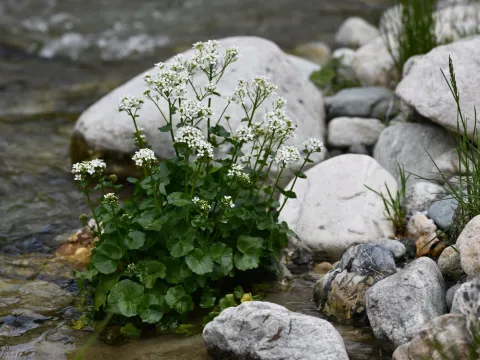
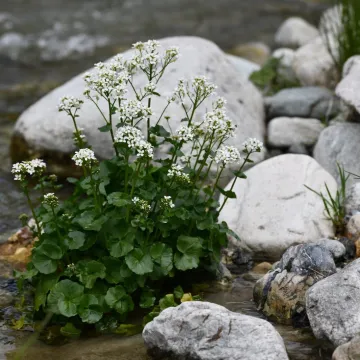
Originating from the mountainous regions of Southern Europe, specifically the Alps and Apennines, this species is naturally adapted to cool, humid conditions. It is typically found near alpine streams and in damp, rocky woods, which dictates its specific ecological requirements in a garden setting.
The plant is characterized by its kidney-shaped, glossy leaves that form a dense basal rosette. The flowers are delicate, four-petaled, and typically white, rising on slender stalks. Its creeping rhizomes allow the plant to spread effectively, creating a ground-covering effect that is aesthetically pleasing and functional for suppressing weeds.
Cultivation requires careful site selection. It thrives in partial to full shade and prefers soil that is consistently moist, rich in organic matter, and slightly acidic to neutral. Providing a cool root run is essential, making it an ideal candidate for rock gardens, woodland edges, or the margins of water features.
- Watering: Must be kept consistently moist; avoid drought stress.
- Soil: Humus-rich, loamy soil with good moisture retention.
- Propagation: Easily increased by division of established clumps in spring.
- Maintenance: Minimal, essentially limited to clearing debris and ensuring mulch for moisture.
While generally robust, the plant can be susceptible to pests such as slugs and snails, which are attracted to the lush foliage in humid conditions. Occasional fungal issues related to soil-borne pathogens can occur if drainage is insufficient, thus emphasizing the need for a well-structured planting medium.
Photo gallery