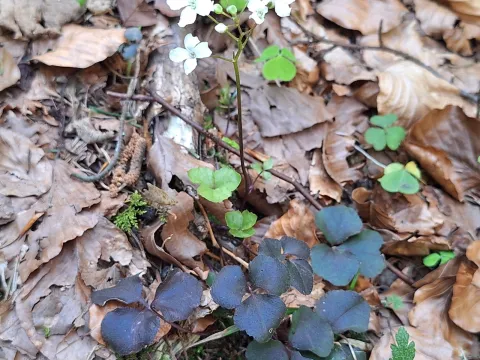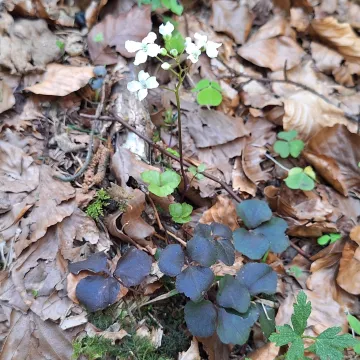
Three-leaved bittercress
Cardamine trifolia
Description
Three-leaved bittercress (Latin Cardamine trifolia) is a perennial herbaceous plant belonging to the Brassicaceae family. Unlike some of its relatives, this species is primarily cultivated as an ornamental ground cover for shaded garden environments rather than as a field crop for consumption.
The plant originates from the mountainous forest regions of Central and Southern Europe. It is naturally adapted to cool, moist habitats with high humus content in the soil. Its native range includes deciduous and coniferous forest understories, where it thrives in relatively stable environmental conditions.
Botanically, it features a creeping rhizome that allows the plant to form dense mats. The leaves are trifoliate, evergreen, and leathery, providing interest throughout the year. In spring, the plant produces short racemes of delicate white four-petaled flowers, which significantly enhance its ornamental value in the landscape.
Regarding cultivation, the plant requires specific environmental conditions to thrive. It performs best in partial to deep shade and requires consistently moist, well-draining, and humus-rich soil. It is highly sensitive to drought and direct afternoon sun, which can cause leaf scorch and hinder its development.
In terms of agricultural and horticultural use, it is a valuable asset for woodland gardening and forest-themed landscape design. It is generally robust against common cruciferous pests and diseases. However, in poorly drained or overly damp conditions, it may be susceptible to fungal rot or slug infestations, which require preventative maintenance through proper planting site selection.
Photo gallery