Hairy whitetop
Cardaria pubescens
Description
Hairy whitetop (Latin: Cardaria pubescens) is a perennial herbaceous plant belonging to the Brassicaceae family. In agricultural contexts, it is widely recognized not as a crop, but as an invasive and highly persistent weed that poses significant challenges for modern farming systems due to its aggressive growth habits.
The plant is native to the regions of Central Asia and the Caucasus, though it has successfully expanded its range across various parts of the world. It is highly adaptable, thriving in semi-arid and temperate climates where it competes aggressively with local vegetation and sown agricultural crops for limited soil resources.
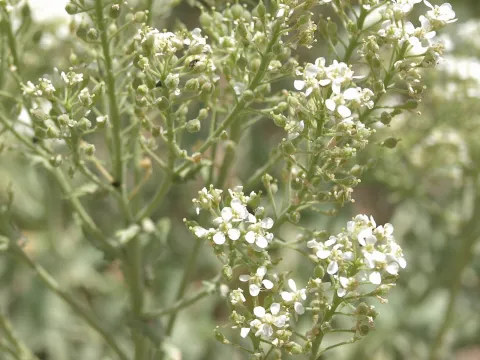
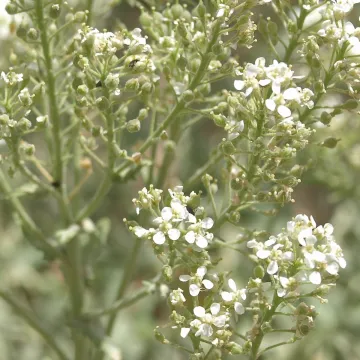
Botanically, it is characterized by its extensive, deep-reaching root system, which allows it to thrive in environments where other plants might fail. The stems are covered with fine hairs, giving it a pubescent appearance. The small, white, four-petaled flowers develop into heart-shaped or globe-shaped silicles, typical of its family.
Hairy whitetop is remarkably hardy, showing high tolerance to saline and drought-prone soils. In terms of agronomic management, eradication is difficult because of its ability to reproduce both through wind-dispersed seeds and vegetative root fragments. Integrated pest management, including systemic herbicides and frequent mechanical tillage, is essential for control.
From an agricultural standpoint, it causes substantial economic damage by reducing the yields of major crops like cereals and forage. As a significant agricultural pest, it requires strict monitoring in fields and along farm borders to prevent it from establishing permanent colonies that can render productive farmland unusable over time.
- Deep, persistent root system.
- Strong drought tolerance.
- High reproductive rate.
- High competitive pressure on crops.
Photo gallery