Cardionema ramosissima
Cardionema ramosissima
Description
Cardionema ramosissima is a hardy perennial herb belonging to the Caryophyllaceae family. In the field of agronomy, this species is recognized for its exceptional resilience to harsh environments, making it a subject of interest for sustainable soil management and land restoration projects.
Originating from South America, the species thrives in diverse geographical zones ranging from coastal dunes to arid mountain slopes. Its native range demonstrates a high level of adaptation to fluctuating moisture levels and poor soil quality, enabling the plant to colonize environments where standard crop species struggle to germinate or establish.
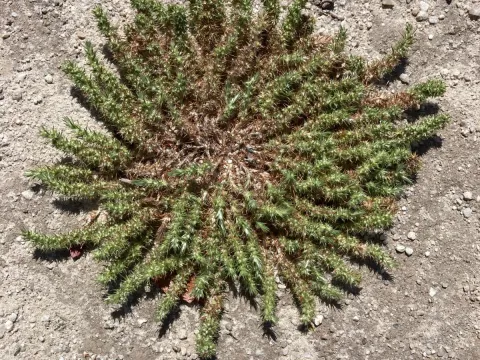
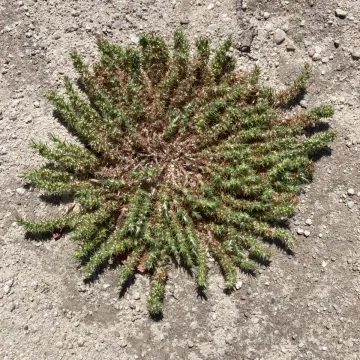
Botanically, it is characterized by its low-growing, mat-forming habit, with densely branched stems that spread along the ground. The leaves are typically small and succulent-like, featuring protective structures that minimize water loss via transpiration. The root system is robust and fibrous, essential for anchoring the plant in shifting, sandy substrates.
Agricultural requirements for Cardionema ramosissima focus on well-draining, sandy or rocky soils. It performs best under minimal irrigation once established, as it is naturally adapted to nutrient-deficient conditions. Agronomic practices usually exclude heavy fertilization, as the plant relies on low-input strategies to maintain its density and structural integrity.
The primary economic use of this plant is in erosion control and soil stabilization, particularly in ecological engineering projects. It is valued for its ability to bind loose soil and prevent wind erosion. Regarding pathology, it remains relatively unaffected by common agricultural pests due to its tough tissue structure and natural chemical defenses, though occasional fungal issues may arise in waterlogged, stagnant conditions.
Photo gallery