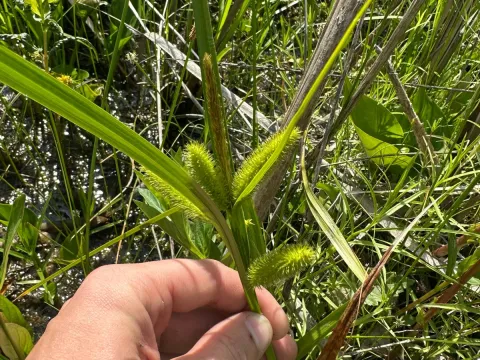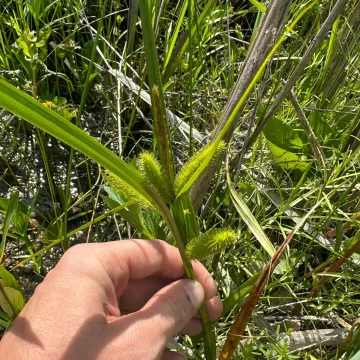
Bristly sedge
Carex comosa
Description
Carex comosa, commonly known as the bristly sedge, is a perennial herbaceous plant belonging to the Cyperaceae family. It is a wetland-adapted species naturally occurring in marshes, wet meadows, and along the margins of lakes and streams throughout North America.
Botanically, the plant is characterized by its dense tufted habit and distinctive, drooping, bristle-like spikes that emerge in the summer. Its foliage is slender, vibrant green, and arching, providing a soft textural contrast in various garden settings. The fruit sacs have unique, hook-like appendages, which aid in seed dispersal by adhering to passing animals or floating on water surfaces.
Regarding its cultivation, Carex comosa thrives in moist to saturated soils. It is highly valued in the horticultural industry for its ability to grow in standing water up to several inches deep, making it an excellent candidate for aquatic landscaping and riparian buffer zones. While it prefers full sun, it can tolerate partial shade, though growth may become more sparse in low-light conditions.
Agrotechnical management primarily involves soil hydration control. Because it is a hydrophytic species, it does not require complex fertilization if planted in nutrient-rich muck or silt soils. Propagation is best achieved by dividing mature clumps during the dormant season, which allows for robust establishment in the following spring.
The practical use of Carex comosa extends beyond aesthetics to ecological services. It is frequently employed in constructed wetlands for water filtration and erosion control, where its fibrous root systems help stabilize substrate. While relatively pest-resistant, growers should monitor for potential fungal issues or leaf-feeding beetles, ensuring adequate spacing for airflow in large-scale installations.
Photo gallery