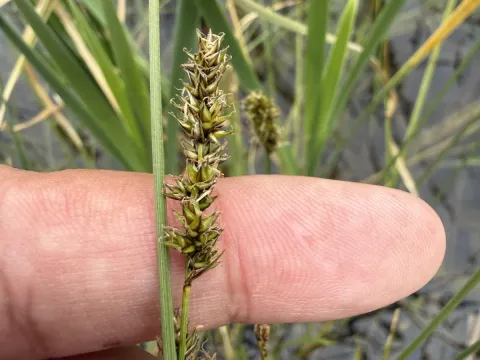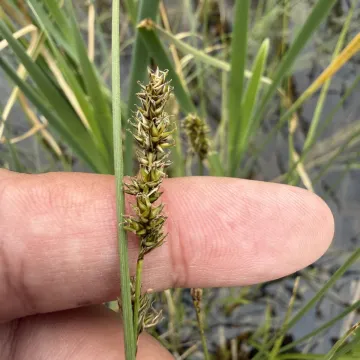
Lesser tussock sedge
Carex diandra
Description
Lesser tussock sedge (Carex diandra) is a perennial herbaceous plant belonging to the Cyperaceae family. In an agricultural and ecological context, it is recognized as a primary wetland species that thrives in nutrient-poor to moderately nutrient-rich fen environments, where it plays a vital role in soil stabilization and biomass production.
The species has a broad native range spanning the temperate and subarctic regions of the Northern Hemisphere. It is predominantly found in Eurasia and North America, typically occupying marshy sites, quaking bogs, and margins of slow-moving water bodies. Its ability to colonize such areas makes it a key species in the successional processes of peatland landscapes.
Botanically, the plant is characterized by its distinctively bunched growth habit and tough, narrow leaves that emerge from a robust root system. The inflorescence consists of a dense, cylindrical cluster of spikelets. A defining feature is its hermaphroditic spikelets, which differentiates it from many other Carex species and is reflected in its specific epithet.
Regarding cultivation and habitat requirements, Carex diandra necessitates water-saturated conditions and specific pH levels in the substrate. It is highly winter-hardy and requires minimal intervention once established. Agronomic management involves maintaining the hydrological integrity of the site to prevent soil drying, which is the primary factor limiting the expansion of this species in semi-managed landscapes.
Economic and land-use applications are focused on conservation and functional vegetation:
- Utilized in phytoremediation for water quality improvement in agricultural drainage systems.
- Employed in soil erosion control for riverbanks and reclamation of peat-mined areas.
- Serving as a secondary forage source in extensive pastoral systems in marshy lowlands.
- Integral to the restoration of wetlands used for biodiversity offsetting.
The health of a Carex diandra stand is generally stable, although it can be susceptible to fungal infections such as smut (Ustilago spp.), which targets the reproductive organs. Insect pests like sedge-borers may occasionally impact growth, but these rarely reach economic threshold levels due to the plant's high resilience and rapid rhizomatous regeneration capacity.
Photo gallery