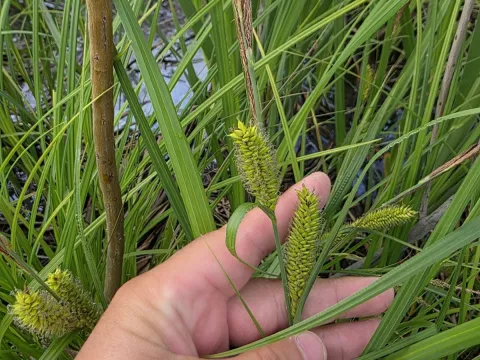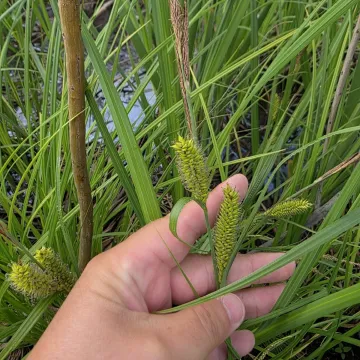
Lake sedge
Carex lacustris
Description
Lake sedge (Carex lacustris) is a robust perennial herb belonging to the Cyperaceae family. It is a prominent wetland species, recognized for its aggressive growth habit and ability to thrive in environments where other terrestrial crops cannot survive.
Native to North America, this species naturally colonizes riparian zones, shallow marshes, and wet meadows. Its geographic range covers various climatic zones, demonstrating significant plasticity and adaptability to diverse moisture conditions, ranging from seasonally saturated soils to standing water.
Botanically, the plant is characterized by its stout, rhizomatous root system, which allows it to form dense, expansive colonies. The stems are triangular and erect, supporting stiff, long leaves that reach lengths of over a meter. These leaves are known for their high cellulose content and overall structural integrity.
Regarding cultivation, lake sedge requires minimal inputs, provided that moisture levels are consistently high. It thrives in loamy or organic-rich soils with a high water table. While it is highly competitive, site preparation involves managing water depths during the establishment phase to ensure successful rhizome rooting.
The agricultural and environmental utility of lake sedge includes its use in erosion control, shoreline stabilization, and biofiltration projects to treat agricultural runoff. While not a primary forage crop due to its coarse texture, it is sometimes harvested for organic mulch, bedding, or as a biomass source for renewable energy production.
- Excellent for shoreline protection
- High biomass productivity in wetlands
- Natural nutrient filter for aquatic ecosystems
- Minimal maintenance once established
Photo gallery