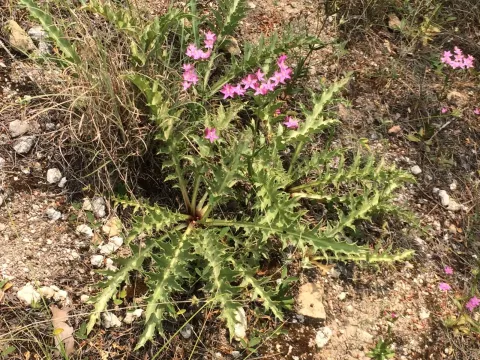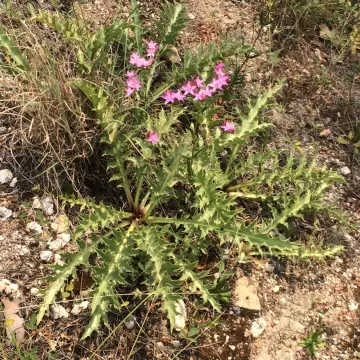
Stemless Carline Thistle
Carlina gummifera
Description
Stemless Carline Thistle (Carlina gummifera), previously known as Atractylis gummifera, is a perennial herbaceous plant belonging to the Asteraceae family. This species is highly distinctive due to its robust root system and its ability to secrete specialized resins, which have been a subject of interest in both botany and ethnopharmacology for centuries.
The plant originates from the Mediterranean basin and is naturally distributed across Southern Europe, North Africa, and the Middle East. It thrives in arid environments, rocky hillsides, and poor, stony pastures. The species is highly adapted to intense sunlight and seasonal drought, making it a challenging but interesting plant for specialized cultivation in dry climates.
Botanically, the plant grows as a low-lying rosette of spiny, leathery leaves that protect the central growing point. During the flowering stage, it produces a large, singular flower head that remains very close to the ground. The taproot is significant, serving as the main storage organ for carbohydrates and complex resins, which help the plant survive prolonged periods without any precipitation.
In terms of agricultural requirements, this crop demands very specific conditions: well-draining, calcareous soil and full solar exposure are critical. The species is prone to root rot if soil moisture levels are too high, so careful site selection is mandatory. Regular irrigation is generally unnecessary once the plant is established, as excessive water often leads to structural failure of the rosette and root system.
The primary economic and scientific applications of Carlina gummifera are centered on its biochemical profile:
- Research into bioactive compounds for pharmacology.
- Extraction of naturally occurring resins for technical applications.
- Xeriscape landscaping in regions with Mediterranean-like climate conditions.
Common pests include soil-borne insects such as nematodes, which can compromise the root structure, and certain species of beetles that feed on the foliage. Disease management is mostly preventative, focusing on avoiding overwatering to curb the development of fungi like Phytophthora. Proper soil aeration is the most effective cultural practice for maintaining the longevity of the plant.
Photo gallery