Glossy shower
Cassia surattensis
Description
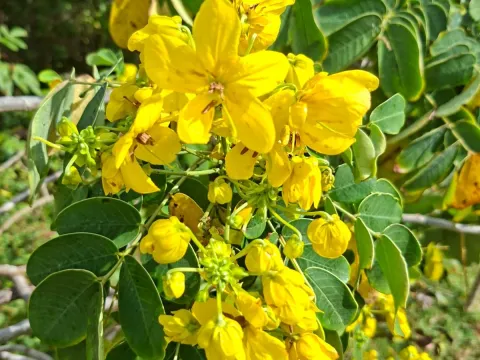
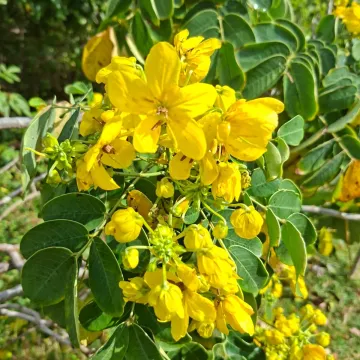
Glossy shower (Cassia surattensis), often recognized by its synonym Senna surattensis, is a fast-growing evergreen shrub or small tree belonging to the Fabaceae family. It is widely cultivated for its aesthetic appeal, specifically its spectacular, prolific display of bright yellow blossoms that appear throughout much of the year.
The species is native to tropical regions of Southeast Asia and Australia. It has been introduced to many tropical and subtropical areas globally, where it has become a staple in urban beautification projects due to its resilience, rapid growth, and ability to thrive in warm climates with minimal maintenance.
Botanically, the plant features alternate, pinnate leaves consisting of several pairs of leaflets that exhibit sleep movements at night. The shrub typically reaches heights of 2 to 5 meters. Its flowers are arranged in terminal clusters, and after pollination, it produces flat, papery seed pods that facilitate easy propagation.
Regarding agrotechnical requirements, this species flourishes in full sun and thrives in well-drained, fertile soil types. It is moderately drought-tolerant once established but requires consistent irrigation during prolonged dry spells to maintain its showy blooming habit. It is highly sensitive to frost, necessitating protected environments or indoor cultivation in temperate climates.
Economic and landscape applications for Cassia surattensis include:
- Establishment of flowering hedges and informal screens in public landscaping.
- Use as a specimen plant to provide bright yellow color accents in gardens.
- Habitat enhancement by attracting butterflies and other essential pollinators.
- Erosion control and landscape stabilization in tropical environments.
Pest management is essential, as the plant can be susceptible to aphids, scale insects, and spider mites, particularly in low-humidity conditions. Fungal leaf spots may occur if air circulation is poor or if the soil remains waterlogged for extended periods. Pruning should be performed after the flowering phase to maintain a compact, healthy structure and remove dead wood.
Photo gallery