Caulanthus crassicaulis
Caulanthus crassicaulis
Description
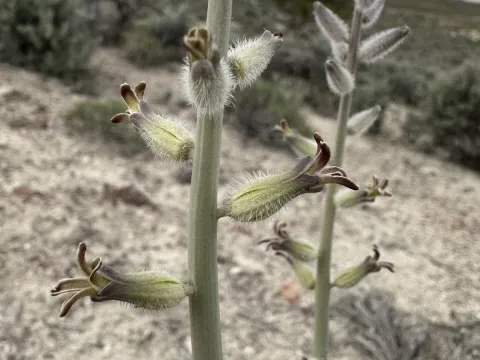
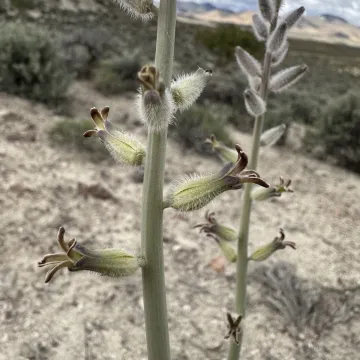
Caulanthus crassicaulis is a distinctive biennial or perennial herb belonging to the Brassicaceae (mustard) family. It is widely recognized in botanical circles for its unique morphology, specifically its thickened, fleshy stem which serves as a reservoir for nutrients and moisture, allowing it to thrive in challenging arid environments.
The plant is native to the western United States, primarily inhabiting the Great Basin region. Its range extends through states like Nevada, Utah, and parts of California, where it is found in sagebrush scrub, pinyon-juniper woodlands, and rocky slopes. These areas are characterized by significant diurnal temperature fluctuations and sporadic precipitation patterns.
Botanically, it features a basal rosette of leaves and a striking, stout flowering stalk that can reach heights of up to one meter. The flowers, which emerge in spring or early summer, display colors ranging from creamy white to deep purplish-maroon. Its root system is relatively deep, enabling the plant to tap into scarce water resources hidden beneath the desert pavement.
Cultivation of this species is rare and primarily restricted to specialized botanical gardens or xeriscaping projects. The plant requires exceptionally well-draining, gravelly, or sandy soils. Soil aeration is paramount, as moisture retention in the root zone quickly leads to fatal fungal infections. Growers must mimic the natural cycle of cold winters and dry, warm springs to successfully complete the plant's life cycle.
In terms of agricultural and ecological usage, Caulanthus crassicaulis is studied for its genetic potential in drought resistance. While not a commercial crop for human consumption, it plays a vital role in its natural habitat by supporting local insect populations. Its resilience to saline conditions makes it a subject of interest for regenerative land management in arid regions susceptible to soil degradation.
- Exceptional tolerance to heat and solar radiation.
- Succulent characteristics of the main stem.
- Sensitivity to nitrogen-rich fertilizers.
- Requirement for a specific vernalization period to trigger flowering.
Photo gallery