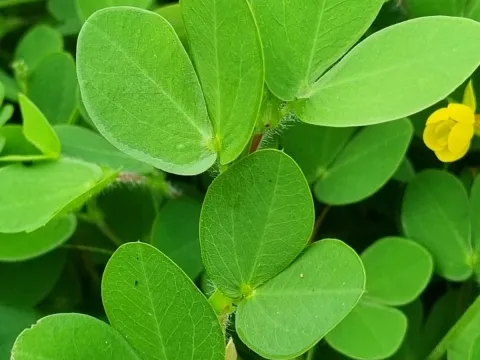

Round-leaf cassia
Chamaecrista rotundifolia (Pers.) Greene
Description
Round-leaf cassia (Chamaecrista rotundifolia) is a perennial leguminous herb or subshrub belonging to the Fabaceae family. Within modern agronomy, it is highly valued for its exceptional adaptability to infertile, acidic soils and its ability to act as a pioneer species in the restoration of degraded agricultural lands and pastures.
The plant is native to the tropical and subtropical regions of the Americas, ranging from the Caribbean to South America. It has been widely introduced across similar tropical climates worldwide, particularly in Australia and parts of Asia, where it serves as a robust component in grazing systems, providing reliable ground cover in challenging environments.
Botanically, this species is characterized by prostrate or semi-erect stems that can root at the nodes when in contact with moist soil. The foliage consists of distinct rounded leaflets, which help the plant tolerate moisture stress. The flowers are typically yellow and solitary, followed by dehiscent pods that disperse small, hard-coated seeds, ensuring the plant persists in the seed bank for subsequent seasons.
Regarding cultivation, round-leaf cassia requires full sunlight to thrive and does not tolerate significant competition from fast-growing weeds during the establishment phase. It is highly drought-tolerant once established and thrives on low-fertility, sandy, and acidic soils. Seed scarification is a standard agronomic practice to overcome physical seed dormancy and ensure uniform germination across the field.
- Primary use as a legume component in pastures for cattle grazing.
- Application in soil erosion control on slopes and sandy embankments.
- Enhancement of soil nitrogen levels through symbiotic nitrogen fixation.
- Provision of a low-maintenance cover crop in tropical orchards.
The most common disease affecting this crop is anthracnose, especially under high-humidity conditions, which can lead to leaf drop and stunted growth. Pest pressures include leaf-eating insects and, in some regions, root-knot nematodes. Effective management strategies involve implementing grazing rotations and maintaining balanced soil nutrient levels to ensure the crop remains competitive and resilient against common pathogens.
Photo gallery