Chamaesaracha coronopus
Chamaesaracha coronopus
Description
Chamaesaracha coronopus is a herbaceous perennial belonging to the Solanaceae (nightshade) family. Often referred to in botanical studies, this species is noted for its adaptability to arid environments. While not a primary commercial crop, it is of interest in agricultural research due to its close phylogenetic relationship with major nightshade crops like tomatoes, potatoes, and peppers.
The plant originates from the arid regions of North America, particularly the southwestern United States and northern Mexico. Its native habitat consists of open plains, disturbed soils, and roadsides where other vegetation struggles to survive. Because of its native range, the plant is highly evolved to withstand significant moisture deficits and intense solar radiation.
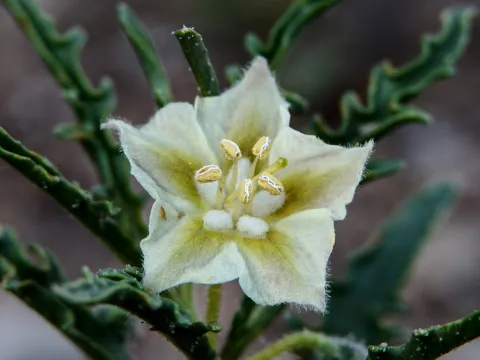
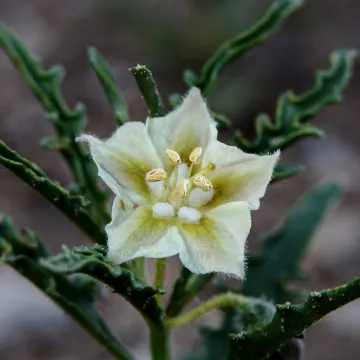
Botanically, it typically grows as a low-spreading subshrub with branching stems. The leaves range in shape from entire to pinnatifid, often presenting a distinct texture. Its flowers are characteristically bell-shaped or rotate, featuring white to pale cream petals with yellow or green centers. The fruit is a small berry that remains partially enclosed by the persistent, accrescent calyx.
Regarding climate and soil requirements, Chamaesaracha coronopus thrives in well-draining, sandy, or gravelly soils. It is highly intolerant of waterlogging, which often leads to root rot in cultivation. The plant prefers full sun exposure and is essentially a drought-tolerant species, requiring minimal irrigation once established, which makes it a subject of interest for low-input agriculture studies.
While the species is not cultivated for food or fiber on a large scale, its potential lies in genetic research for breeding drought-hardy agricultural crops. Cultivators should be aware of common Solanaceae pests and pathogens that may affect the plant, which include:
- Aphids, which can transmit viral diseases;
- Colorado potato beetle larvae;
- Various root rot pathogens favored by stagnant soil moisture;
- Fungal infections such as powdery mildew in humid microclimates.
Photo gallery