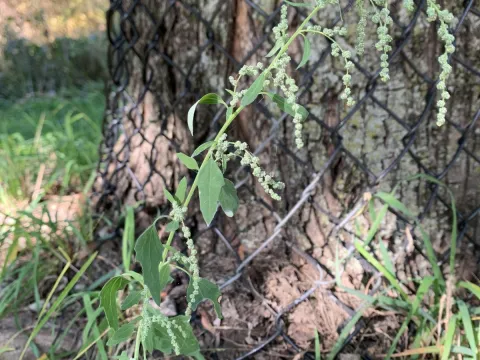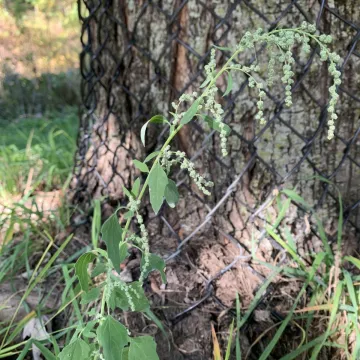
Missouri goosefoot
Chenopodium missouriense
Description
Missouri goosefoot (lat. Chenopodium missouriense) is an herbaceous plant belonging to the Amaranthaceae family. While frequently categorized as a common weed in agricultural fields, it is increasingly studied for its agricultural potential, particularly as a hardy forage crop or a source of nutrient-dense seeds in varied environmental conditions.
Native to North America, the species has demonstrated a remarkable ability to colonize and thrive in a wide range of geographical areas. Its current distribution spans several continents, where it adapts to diverse climates, often thriving in disturbed soils, roadsides, and areas converted for agricultural use, showing significant ecological resilience.
Botanically, the plant is characterized by an erect, branched stem and alternate leaves often coated in a mealy, granular substance, which is a hallmark of the genus. Its flowers are tiny, clustered in dense spike-like or paniculate inflorescences. The plant can reach a height of approximately one meter, depending heavily on the availability of nutrients and competition for sunlight.
Regarding soil and climatic requirements, Missouri goosefoot prefers well-drained soils rich in nitrogen, though it is highly tolerant of varying soil pH levels. Successful cultivation requires careful management of seed density at the early stages of development. Regular weeding or appropriate planting patterns are essential to maintain the productivity of the stands and ensure optimal development of the canopy.
In terms of agricultural utility, the plant is valued for its rapid biomass production, making it a viable candidate for experimental forage systems. It is also noted for its potential as a seed crop. Although the plant can be susceptible to typical amaranth pests like aphids or spider mites, it remains relatively robust against major bacterial and fungal pathogens, which simplifies the overall management strategy.
- High environmental adaptability.
- Significant biomass production potential.
- Nutrient-rich seed characteristics.
- Low susceptibility to severe crop diseases.
Photo gallery