Guelder-leaved goosefoot
Chenopodium opulifolium
Description
Guelder-leaved goosefoot (Chenopodium opulifolium) is an annual herbaceous plant belonging to the Amaranthaceae family. In agronomy, it is primarily recognized as a weed that infests various arable lands. Despite its wild status, it belongs to the same genus as several economically important crops, including quinoa, sharing many of their physiological traits and environmental adaptability.
The origin of this species is broadly tied to the Eurasian and North African regions. Its natural range has expanded globally, making it common in diverse temperate and subtropical environments. It thrives in nitrogen-rich soils, frequently appearing in agricultural fields, along roadsides, and in disturbed urban areas where it competes successfully with native and cultivated plant species.
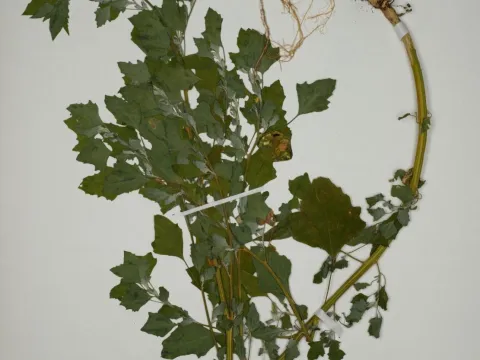
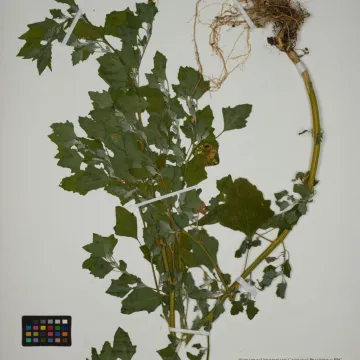
Botanically, the plant is distinguished by its leaves, which are rhombic-ovate with obtuse teeth, resembling those of the snowball tree (Viburnum opulus), giving it its specific name. The plant typically reaches heights of up to one meter. It produces dense inflorescences of tiny, greenish flowers that generate a vast quantity of seeds, ensuring a persistent seed bank in the soil that can survive for several seasons.
Agricultural management of Chenopodium opulifolium focuses on preventive and curative measures. It is a hardy plant that shows tolerance to various environmental stressors and poor soil conditions. Effective control strategies include systematic crop rotation, deep mechanical cultivation to bury seeds before germination, and the judicious use of selective herbicides, though the plant's rapid growth requires early intervention.
In terms of economic use, while primarily seen as a nuisance, the plant is studied for its chemical composition. Some regional practices acknowledge its use as a minor forage source for livestock, provided it is harvested before seed maturation. Furthermore, as a wild relative of agricultural species, it remains an object of botanical interest for researchers looking to improve crop resilience and drought tolerance through genetic studies.
- High seed production and environmental persistence.
- Competitive growth habit in agricultural settings.
- Wide range of tolerance to soil types and pH levels.
- Potential research interest in genetic crop improvement.
Photo gallery