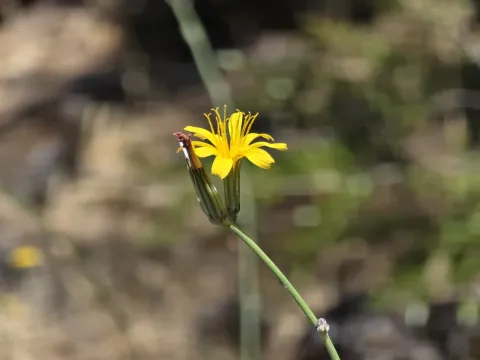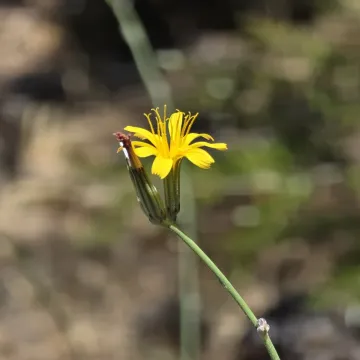
Skeleton weed
Chondrilla juncea L.
Description
Skeleton weed (Chondrilla juncea L.) is a perennial herb belonging to the Asteraceae family. Known in agricultural circles for its resilience and competitive nature, it is widely recognized as a serious weed that affects productivity in a variety of crop systems, particularly in dryland farming regions.
The plant is native to Southern and Central Europe, as well as Western Asia. It has successfully naturalized in many parts of the world, including significant areas of North America and Australia, where it is considered a major invasive species. It thrives in light, sandy, or stony soils and is commonly found in pastures, along roadsides, and in cultivated crop fields.
Botanically, skeleton weed is characterized by a deep taproot system that can penetrate the soil to depths exceeding two meters, providing access to water inaccessible to many crops. The plant possesses a distinctive, highly branched, rush-like stem with reduced leaves, which reduces transpiration. It produces vast quantities of wind-dispersed seeds and can also reproduce vegetatively from root fragments.
Management of this weed is notoriously difficult due to its capacity for rapid regrowth from root buds. Agronomic control strategies focus on integrated pest management (IPM), including deep tillage to exhaust nutrient reserves in the roots, and the application of systemic herbicides. Rotating crops with competitive species can help suppress its growth, but persistence is key to reducing its presence.
- Requires well-drained, porous soils.
- High tolerance to drought conditions.
- Effective spread via seed and root pieces.
- Negative impact on yield by depleting soil moisture.
Historically, skeleton weed has been studied for its latex content, with investigations into its potential as a source of natural rubber. However, its primary impact today remains the economic challenge it poses to farmers, necessitating ongoing research into biological control agents and chemical management to protect crop yields and soil integrity.
Photo gallery