Blue mustard
Chorispora tenella (Pall.) DC.
Description
Blue mustard (Chorispora tenella), also known as the purple mustard, is an annual forb belonging to the Brassicaceae family. While primarily recognized as a significant weed in agricultural settings, its biological resilience makes it a persistent presence in various managed landscapes.
Originating from Central and Western Asia, blue mustard has expanded its range significantly, establishing itself in parts of Europe and North America. It thrives in temperate regions, frequently colonizing grain fields, pastures, and disturbed soil areas where it can readily outcompete native or planted vegetation.
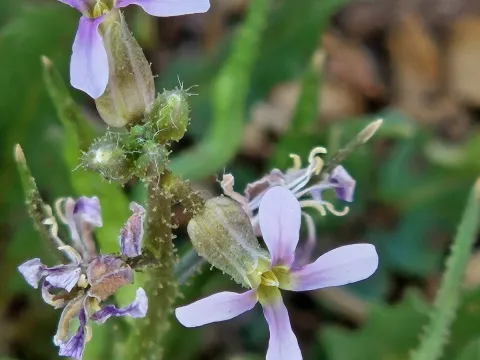
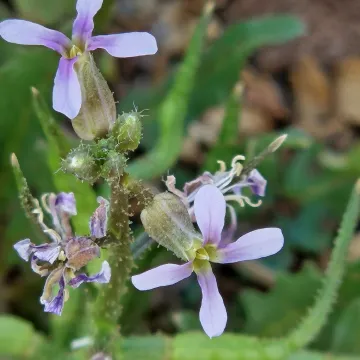
Botanically, it is characterized by its distinct purple to violet flowers and glandular hairs covering the stems and leaves. A notable feature is the fruit development: the elongated pods break transversely into segments, each containing a seed. This adaptation facilitates wide dispersal through wind, water, and human activity.
The plant demonstrates remarkable environmental adaptability, showing high tolerance to cold climates and drought. It grows well in various soil types, including alkaline or slightly saline soils. Its ability to germinate early in the spring often gives it a head start over spring crops, allowing it to extract early-season soil nutrients and moisture effectively.
In terms of agricultural impact, blue mustard is viewed as a pest that reduces crop yield and complicates harvesting procedures. Management practices include preventive measures like clean seed certification, mechanical weeding, and the application of selective herbicides during the early stages of plant development to prevent the formation of seeds.
- Rapid growth cycle that peaks before summer heat.
- Significant seed bank longevity in cultivated soils.
- Strong competitive capacity against small grain crops.
- Host potential for various pests and pathogens affecting cruciferous vegetables.
Photo gallery