Bastard toadflax
Comandra umbellata
Description
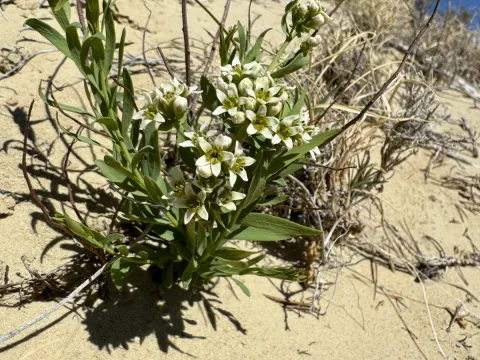
Bastard toadflax (Comandra umbellata) is a perennial herbaceous plant belonging to the Santalaceae family. It is distinct in its biological strategy as a hemiparasite, meaning it derives water and nutrients from the root systems of host plants via specialized organs called haustoria, while still retaining the ability to photosynthesize independently.
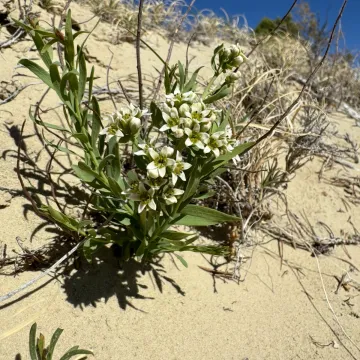
The native range of this species covers vast areas of North America, stretching across the United States and Canada. It is commonly found in dry prairies, open woodlands, and sandy dunes. Due to its evolutionary history, it has adapted to thrive in nutrient-poor soils and under conditions of water stress, where it outcompetes less hardy species by leveraging its host-dependent nutrition system.
Botanically, Comandra umbellata grows to a height of about 15–40 centimeters. Its structure consists of erect or branched stems adorned with alternate, lanceolate, glaucous leaves. The flowers are small, typically white or greenish, arranged in terminal umbel-like clusters. The root system is relatively complex, designed to facilitate the necessary physical contact with the roots of diverse woody and herbaceous plants.
When considering its growth requirements, the plant demands well-drained soil and adequate exposure to sunlight. Cultivation is generally not practiced on a commercial scale, but for restoration ecology or botanical research, it is crucial to ensure that suitable host plants are present in the immediate vicinity to support its development. It is highly resistant to traditional agricultural pests.
- Adaptation to various soil types, particularly sandy and rocky soils.
- Hemiparasitic nature requiring host plant interaction.
- High tolerance to drought and thermal fluctuations.
- Limited susceptibility to common agricultural pathogens.
In terms of agricultural and commercial use, Comandra umbellata is primarily valued for its role in ecological conservation rather than as a primary crop. It contributes to the stabilization of soil in fragile habitats and supports local biodiversity. Recent research continues to investigate its potential in pharmacological studies due to its unique chemical constituents derived from its interaction with host plants.
Photo gallery