Corchorus schimperi
Corchorus schimperi
Description
Corchorus schimperi is a resilient herbaceous plant species belonging to the Malvaceae family. It is taxonomically related to the jute plant (Corchorus capsularis), sharing similar structural properties in its stems, which make it a subject of interest for fiber crop research in arid and semi-arid environments.
The origin of this species is traced back to Northeastern Africa. Its natural distribution is primarily found in regions with significant temperature fluctuations and irregular rainfall. Due to these evolutionary origins, the plant has developed robust survival mechanisms, allowing it to thrive in environments where many other traditional fiber crops would struggle to survive.
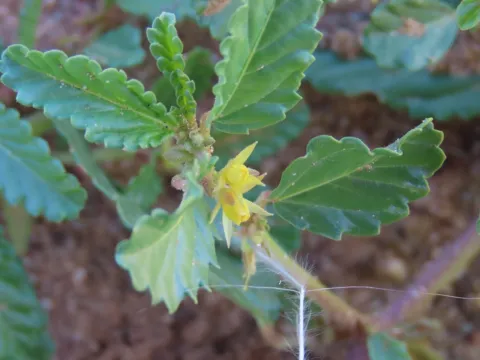
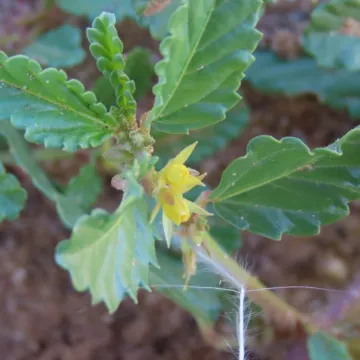
Botanically, it typically presents as an annual herb or a small shrub. It features simple, alternate, and serrated leaves. The small yellow flowers are typical of the Malvaceae family, and the fruit is a multi-valved capsule. These structural characteristics are adapted for efficient seed dispersal in the dry landscapes where the plant is native.
Agricultural cultivation requires well-drained, sandy-loam soils and full exposure to sunlight. The plant is notably heat-tolerant and requires irrigation management during the seedling establishment phase. Once mature, it shows significant resilience to environmental stressors, though soil fertility must be managed with nitrogen supplementation to ensure sufficient biomass production for fiber harvesting.
In terms of economic utility, the plant is studied for its potential in producing bast fiber used for cordage and coarse textile materials. While it is not as widely cultivated as other industrial Corchorus species, its ecological niche makes it a valuable candidate for drought-prone agricultural systems. Management of pests, such as aphids and specific beetles, remains an essential part of maintaining a healthy crop.
- Excellent tolerance for high-temperature climates.
- Preference for well-aerated, non-saline soils.
- Requires strategic nitrogen fertilization for stalk elongation.
- Potential use in sustainable textile and paper industries.
Photo gallery