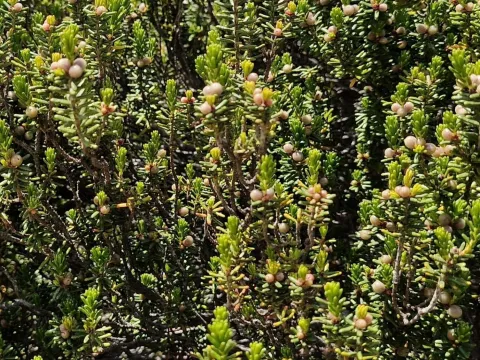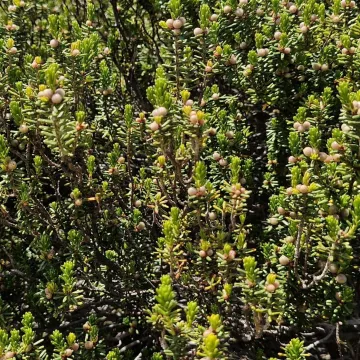

White crowberry
Corema album
Description
White crowberry (Corema album) is an evergreen shrub belonging to the Ericaceae family. Known for its resilience, this plant has adapted to survive in challenging, low-nutrient environments. It is increasingly studied for its horticultural potential, particularly in maritime regions where other berry crops struggle to thrive.
The native range of this species is limited primarily to the Atlantic coast of the Iberian Peninsula. It is typically found in coastal dune systems, which dictates its preference for sandy, acidic substrates. Its ability to stabilize soil and survive in salty winds makes it a valuable species for ecological restoration and specialized agricultural projects.
Botanically, Corema album is a dioecious species, requiring both male and female plants for successful fruit production. The leaves are small, narrow, and leathery, an evolutionary adaptation to arid coastal winds. The fruit is a drupe-like berry, usually white or slightly translucent, which develops after the spring flowering period.
Cultivation requires specific conditions: well-drained, acidic soil is essential to mimic the plant's natural habitat. Standard agricultural practices include:
- Maintaining soil pH between 4.5 and 5.5.
- Providing excellent drainage to prevent root diseases.
- Minimal fertilization, as the plant is adapted to nutrient-poor soils.
- Protecting young plants from harsh frosts during the first years.
In terms of economic use, the berries are valued for their taste and are utilized in local gastronomy. However, the plant is also susceptible to fungal pathogens like Phytophthora if the soil remains waterlogged. Monitoring for pests, such as spider mites and aphids, is crucial during the growing season to ensure healthy yields and plant longevity.
Photo gallery