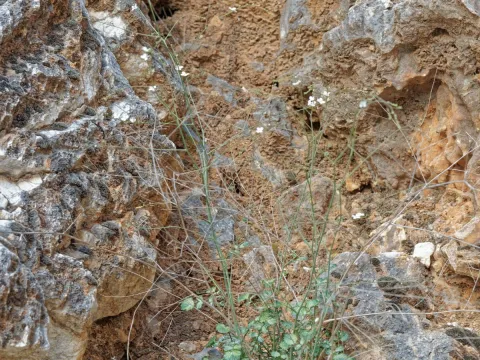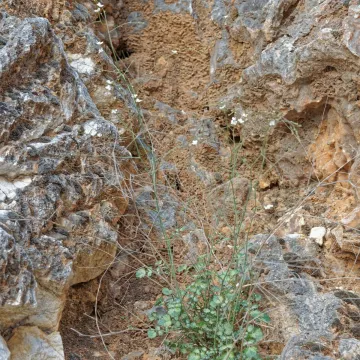

Crambe filiformis
Crambe filiformis
Description
Crambe filiformis is a distinctive member of the Brassicaceae family. While it is not a widely cultivated crop in the commercial sense, it serves as a valuable genetic resource due to its adaptation to harsh environments and its relationship with more economically significant oil-bearing species within the same genus.
The plant is native to Mediterranean regions, thriving in rocky and arid habitats. Its historical distribution indicates a high degree of resilience to high temperatures and limited water availability, making it an ideal subject for studies related to climate change adaptation in agriculture.
Botanically, Crambe filiformis is characterized by its slender, filiform (thread-like) stems and a basal rosette of finely divided leaves. The inflorescence consists of small white flowers arranged in branching panicles. Its deep taproot system is its primary adaptation strategy, allowing it to survive in depleted or shallow soil conditions.
Regarding cultivation, the plant requires excellent drainage and a sunny environment. It is poorly suited for heavy, waterlogged clay soils, which can induce root rot. In an agricultural setting, precision sowing is necessary because the plant exhibits slow early development, requiring careful management of surrounding weed competition.
Industrial and agricultural potential for Crambe filiformis lies mainly in its specialized chemical composition. Like many other Crambe species, it produces seeds containing oils that may be utilized in industrial lubricants or as raw materials for bio-polymers. Future research aims to integrate its drought-tolerance traits into commercial crop varieties to improve yields in arid regions.
- High tolerance to arid conditions
- Deep root system for soil stabilization
- Specific oil profile in seeds
- Suitability for low-input agricultural systems
Photo gallery