Calabash tree
Crescentia cujete L.
Description
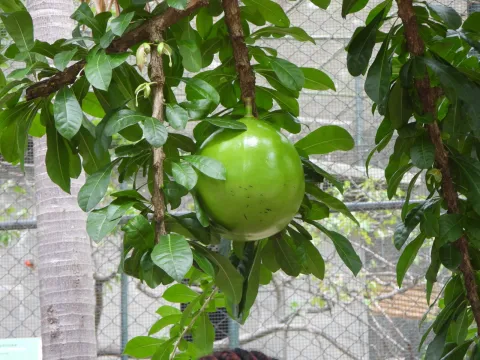
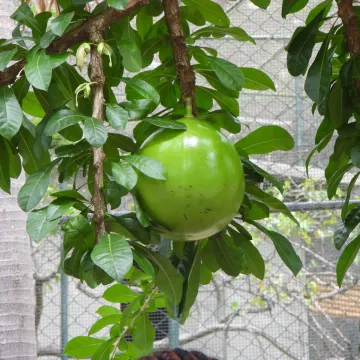
The calabash tree, botanically identified as Crescentia cujete L., is a member of the Bignoniaceae family. It is a slow-growing, evergreen tree native to the tropical regions of the Americas, widely recognized for its large, spherical fruits that develop a hard, woody shell upon maturation.
The tree thrives in tropical environments, primarily across Central and South America and the Caribbean. It is highly valued for its ability to grow in various soil types, provided there is adequate moisture and protection from severe cold, as it is strictly a tropical plant that cannot tolerate temperatures below freezing.
Botanically, the calabash tree is characterized by its spreading, low-hanging branches and simple, lanceolate leaves. It exhibits the interesting phenomenon of cauliflory, where pale, bell-shaped flowers bloom directly on the bark of the trunk and older branches, which eventually give rise to the massive, gourd-like fruits.
From an agronomical perspective, the tree requires minimal intervention once established. It prefers fertile, well-draining soils but can adapt to less ideal conditions. Regular pruning is recommended to maintain the tree's health and to ensure optimal access to the fruit, which is harvested manually once the shell is sufficiently hardened and brown.
Economically, the calabash tree is cultivated primarily for its hard-shelled fruits, which are processed into bowls, ladles, containers, and traditional musical instruments. While not a primary food source, the tree plays a significant role in local cottage industries. Pest management typically involves monitoring for scale insects or aphids, which can occasionally affect the foliage.
Photo gallery