Sea crosswort
Crucianella maritima
Description
Crucianella maritima, commonly known as sea crosswort, is a perennial herbaceous plant belonging to the Rubiaceae family. This species is a specialized psammophyte, evolutionarily adapted to the harsh, nutrient-poor, and unstable environments of coastal sand dunes.
The plant originates from the Mediterranean and Black Sea basins. Its natural habitat consists of frontal and shifting dunes, where it plays an essential ecological role. By developing extensive underground rhizome networks, the plant stabilizes the sand, preventing erosion and creating favorable conditions for subsequent plant colonization.
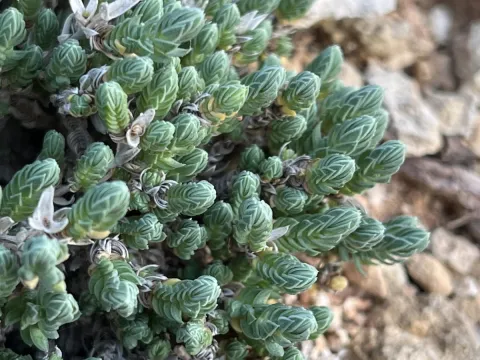
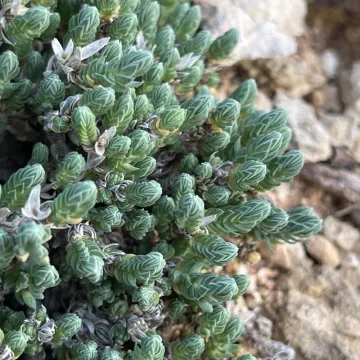
Botanically, Crucianella maritima features narrow, whorled leaves that are adapted to reduce transpiration. The inflorescences are dense, terminal spikes bearing small, cream-colored flowers. The plant exhibits high salinity tolerance, allowing it to thrive in zones directly exposed to sea spray, which would be toxic to most agricultural crops.
Regarding agrotechnical requirements, the plant demands well-drained, sandy substrates with low moisture retention. In an artificial setting, it requires full sunlight and complete avoidance of waterlogging. While it does not require significant fertilization, it is highly sensitive to soil compaction and competition from invasive plant species.
The primary economic and environmental use of this species is in phytoremediation and land restoration. It is increasingly used in coastal engineering to stabilize embankments and restore degraded beach ecosystems. Due to its unique appearance and hardiness, it is also gaining popularity in xeriscaping and coastal garden designs.
- Excellent adaptation to shifting sands.
- High tolerance to sea-salt spray.
- Low nutrient and water requirements.
- Effective barrier against wind erosion.
Photo gallery