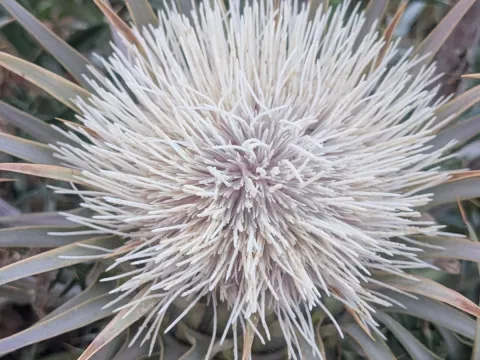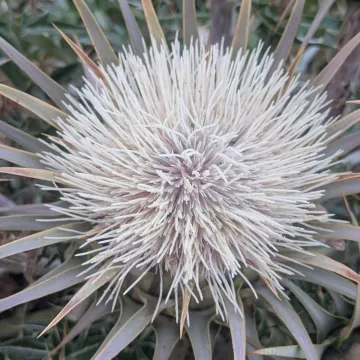
Horned artichoke
Cynara cornigera
Description
The horned artichoke (Cynara cornigera) is a perennial herbaceous plant belonging to the Asteraceae family. Known for its distinct spiny appearance, it thrives as a wild or semi-cultivated crop across the Mediterranean region, where it has been traditionally harvested for its edible flower heads and succulent heart parts.
The plant originates from the Eastern Mediterranean, with its range extending across the Levant, Greece, and parts of North Africa. It is highly adapted to semi-arid climates, typically flourishing in rocky terrain, uncultivated pastures, and sun-drenched hillsides where traditional vegetables would struggle to survive.
From a botanical perspective, Cynara cornigera is characterized by a basal rosette of large, deeply lobed, and prickly leaves. The flowering heads are protected by thick, spiny involucral bracts that curve outwards, resembling small horns. Its deep taproot is a key physiological adaptation that enables the plant to access groundwater reserves during intense summer heat.
Agricultural success with this species requires well-drained, porous soils that prevent waterlogging, as the root system is sensitive to excessive moisture. The crop demands full sun exposure throughout its life cycle to maintain vigorous growth and produce quality inflorescences. Standard maintenance involves effective weed management during the early vegetative phase to ensure the plant can establish itself.
Economically, the horned artichoke is valued for its culinary potential, often prepared in traditional recipes similar to standard globe artichokes. Regarding plant health, the most common threats are powdery mildew and aphid infestations. Preventive measures include ensuring good spacing between individual plants to promote air circulation and monitoring for pests during the early spring developmental stage.
In summary, Cynara cornigera represents a resilient agricultural asset for dry-land farming. Its ability to produce nutritional flower heads under minimal input conditions makes it an interesting subject for sustainable agriculture in arid environments, focusing on the preservation of local genetic diversity and traditional food systems.
Photo gallery