Clustered flatsedge
Cyperus glomeratus
Description
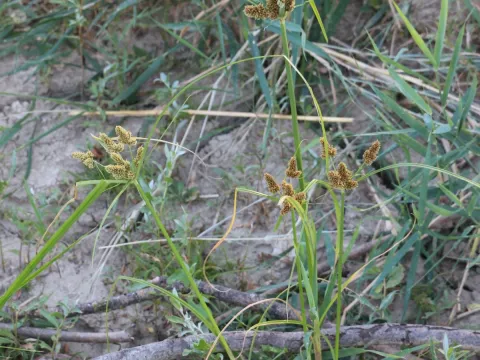
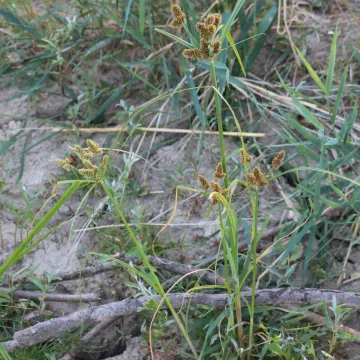
Clustered flatsedge (lat. Cyperus glomeratus) is a herbaceous perennial plant belonging to the Cyperaceae family. It is a moisture-loving species that plays a significant role in wetland ecosystems and, under certain agricultural conditions, is regarded as a notable weed in flooded crops such as rice and other hydromorphic fields.
The native distribution of this plant includes extensive regions across East Asia and parts of the Russian Far East. As a hydrophyte, it thrives in environments characterized by high water tables, such as riverbanks, marshes, irrigation ditches, and water-saturated soils. Its ability to colonize wet ground makes it a characteristic species in both natural wetlands and modified agricultural landscapes.
Botanically, the plant is distinguished by its erect, triangular stems that typically reach heights of 80 to 100 cm. The foliage consists of narrow, linear leaves concentrated at the base. The inflorescence is unique, consisting of dense clusters of spikelets that give the plant its characteristic appearance. It possesses a robust root system, including short rhizomes that facilitate clonal growth and persistence.
Clustered flatsedge thrives in moist, silty, or clay-rich soils. It exhibits a high tolerance for anaerobic conditions in the soil, which is a key adaptation for survival in waterlogged habitats. The plant generally prefers open, sunny locations with stable moisture levels throughout the growing season, showing strong resilience to varied climatic conditions within its range.
In agricultural practice, it is primarily managed as a weed due to its aggressive growth, which can severely reduce yields by competing for resources in rice cultivation. Effective management strategies involve land drainage, crop rotation, and the application of herbicides specifically targeting sedge species. Beyond its status as a weed, it is sometimes studied for its role in phytoremediation and potential use in artificial wetland design.
- Adaptation to waterlogged soil conditions.
- Aggressive vegetative and seed propagation.
- High competitive impact on flooded crops.
- Tolerance to low-oxygen environments.
Photo gallery