Green flatsedge
Cyperus virens
Description
Green flatsedge (Cyperus virens) is a perennial herbaceous plant belonging to the Cyperaceae family. In agricultural and ecological contexts, it is recognized as a robust species capable of thriving in saturated soil conditions where many traditional field crops would fail to survive.
Native to the Americas, this species is widely distributed across tropical and subtropical environments. It is naturally found in wetlands, marshy meadows, and along riverbanks. Its ability to tolerate flooding and stagnant water makes it a key species in riparian ecosystems throughout its native range.
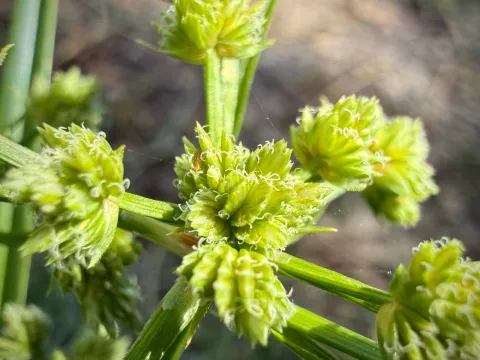
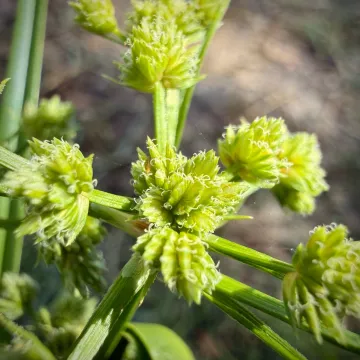
Botanically, Cyperus virens is defined by its triangular stem and basal leaves that create dense, fountain-like tufts. The inflorescences are umbrella-shaped, comprising numerous small green spikelets. The plant relies on a fibrous and spreading root system, which is instrumental for soil stabilization in saturated terrain.
The agronomic requirements for this plant focus on high water availability and nutrient-rich, silty substrates. In cultivation, it is essential to manage the hydrological conditions to prevent desiccation. It is not traditionally managed as a grain crop but is valued for its rapid biomass accumulation, which can be harvested for compost or specific industrial applications.
Regarding its utility, the species is predominantly used in phytoremediation projects, erosion control on embankments, and as a natural buffer zone in agricultural fields to reduce runoff. Like many sedges, it is generally hardy, though it may be susceptible to fungal leaf spots under poor air circulation and occasional infestations by aphids or stem-boring insects. Successful management involves monitoring moisture levels and removing competing invasive weeds in the early establishment phase.
Photo gallery