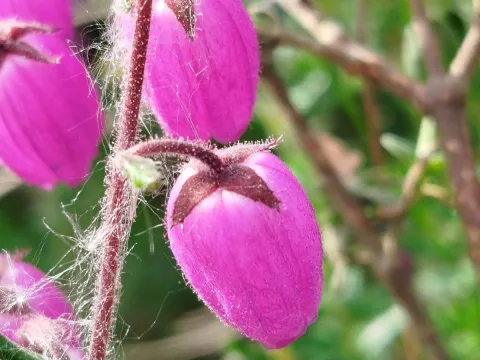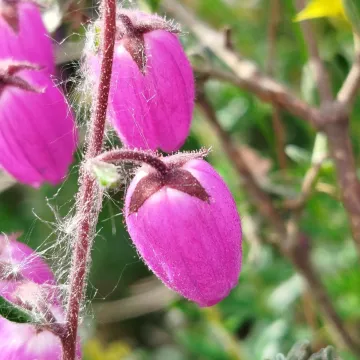
Daboecia cantabrica
Daboecia cantabrica (Huds.) K. Koch
Description
Daboecia cantabrica, commonly known as St. Dabeoc's heath, is a low-growing evergreen shrub belonging to the Ericaceae family. It is widely recognized in horticulture for its spectacular, bell-shaped flowers and dense foliage. This plant is a quintessential element of heath gardens, providing a sophisticated texture and vibrant color that persists throughout the growing season.
The plant originates from the Atlantic regions of Western Europe, including Ireland, France, and the Iberian Peninsula. Its natural habitat consists of damp, acidic heaths and moorlands where the climate is mild and maritime. Due to these origins, Daboecia cantabrica thrives in regions with temperate climates, preferring consistent moisture and protection from harsh, drying winds during the winter months.
Botanically, this species is characterized by its stiff, upright stems and dark, glossy leaves that are distinctively white-tomentose on the undersides. The inflorescences are racemes of pendulous, urn-shaped flowers which appear in shades of pink, purple, or pure white. Its growth habit is typically bushy and compact, making it an excellent choice for ground cover or low-maintenance borders in well-drained, acidic soil.
Regarding agrotechnical requirements, Daboecia cantabrica demands an acidic soil environment with a pH between 4.5 and 5.5. It is essential to provide a well-drained substrate, as the roots are sensitive to stagnant water which leads to fungal infections. Mulching the base with peat or pine needles is a standard practice to maintain soil acidity, moisture retention, and to protect the root system from temperature fluctuations.
Cultivation challenges primarily involve physiological stress caused by unsuitable soil pH or improper drainage. Pests such as spider mites may occasionally infest the foliage, particularly in sheltered or dry conditions. To maintain health, regular pruning of faded flower spikes is recommended to encourage bushiness. Disease management focuses on avoiding root rot by ensuring the site has excellent soil permeability and adequate airflow.
Photo gallery