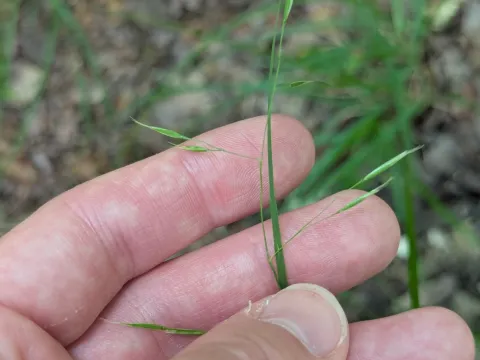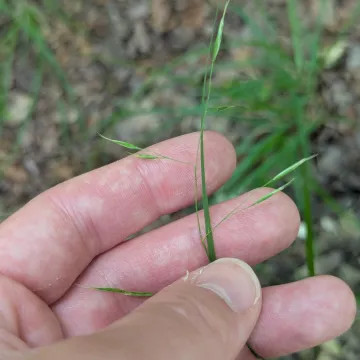
Flattened oatgrass
Danthonia compressa
Description
Flattened oatgrass (Danthonia compressa) is a perennial grass species belonging to the Poaceae family. This plant is recognized for its ability to form dense sod and persist in varied environmental conditions, making it a valuable component of native grasslands and managed pastures in temperate regions.
The species is native to North America, with a broad distribution ranging from Canada down to the United States. It naturally thrives in diverse habitats, including rocky slopes, meadows, and open woodland clearings. Its evolutionary history in these varied terrains has equipped it with strong resilience to environmental stressors.
Botanically, this grass is characterized by its tufted growth habit and slender, often flattened, stems that reach heights of 30 to 80 centimeters. The leaves are typically narrow and may be smooth or slightly hairy. The defining feature is its condensed, spike-like panicle, from which its common name is derived. The root system is robust, providing stability and allowing the plant to thrive even in nutrient-poor soils.
Agronomic requirements focus on cool-season growth patterns. Danthonia compressa prefers well-drained, acidic to neutral soils and can withstand significant seasonal temperature fluctuations. It is particularly well-suited for high-elevation sites or regions with limited soil depth where more demanding crop species might struggle to establish.
Economic and agricultural uses for this species include:
- Providing forage for livestock in extensive pasture systems.
- Stabilizing soil on steep or erosion-prone slopes.
- Restoring native vegetation in reclamation projects.
- Integrating into seed mixes for long-term conservation grasslands.
Regarding health, the flattened oatgrass is naturally resistant to most major agricultural pests and diseases. While it may occasionally experience fungal infections such as rust or leaf spot during prolonged periods of high humidity, these outbreaks are rarely devastating. The best protection is maintaining a healthy soil drainage and preventing overgrazing, which ensures the grass remains vigorous and competitive.
Photo gallery