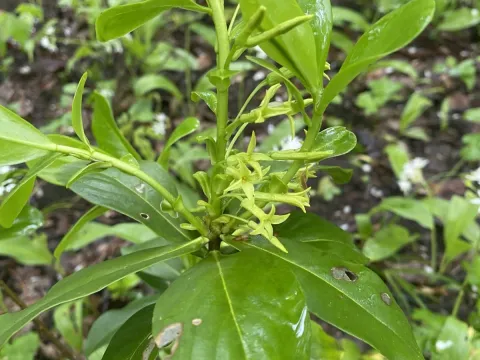

Pontic daphne
Daphne pontica
Description
Pontic daphne (Daphne pontica) is an evergreen ornamental shrub belonging to the Thymelaeaceae family. It is recognized for its dense, glossy foliage and early spring blooming, which adds significant value to shade gardens and woodland borders.
The plant originates from the mountainous forests of the Caucasus, Turkey, and parts of the Balkans. In agricultural and horticultural contexts, it is grown primarily as a decorative plant in regions with mild to moderate climates, serving as an excellent ground-covering shrub for protected areas.
Botanically, this shrub is characterized by its lanceolate, leathery leaves arranged in dense clusters. During the flowering period, it produces fragrant, greenish-yellow flowers. Gardeners must handle this plant with caution, as all parts contain toxic compounds that can cause severe irritation upon contact.
Successful cultivation requires a location with rich, well-draining soil and a consistent supply of moisture. It thrives in partial shade, as the foliage is susceptible to scorching under direct sunlight. A cool root zone is essential for the longevity of the plant, which can be achieved through regular mulching.
Maintenance tasks include monitoring for excessive moisture during winter and ensuring the soil remains slightly acidic. While generally resilient to pests, Daphne pontica can occasionally suffer from root rot if drainage is insufficient. Propagation is typically achieved via semi-ripe cuttings, as growth from seeds is slow and difficult.
- High tolerance for deep shade.
- Requires consistent soil moisture and organic matter.
- Very important to wear gloves due to potential sap toxicity.
- Suitable for naturalistic woodland garden designs.
Photo gallery