Sacred datura
Datura wrightii
Description
Sacred datura (Datura wrightii) is a herbaceous perennial plant belonging to the Solanaceae family. Often confused with other species of the genus, it is recognized for its significant size and distinctive nocturnal flowering behavior, serving both as an ornamental specimen and a source of alkaloids in pharmaceutical research.
Native to the southwestern United States and Mexico, this species thrives in arid environments. It is naturally found in riparian zones, canyons, and open grasslands. Its ability to tolerate extreme heat and drought makes it a hardy plant in its native range, though it requires specific seasonal management when grown outside of its natural habitat.
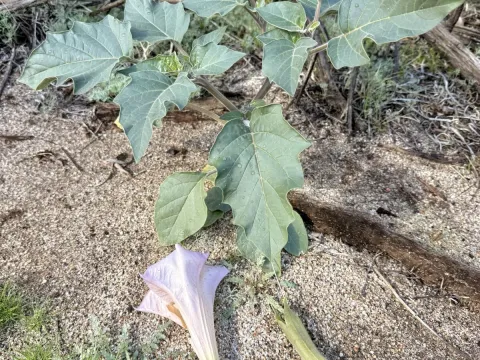
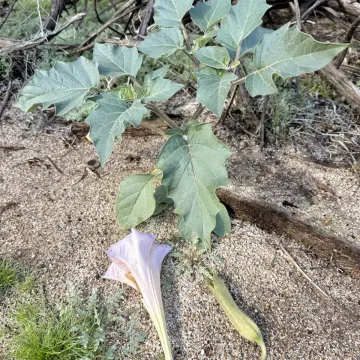
The plant features large, trumpet-shaped white flowers with purple accents, which emit a potent fragrance at night. The leaves are broad, velvety, and soft to the touch, while the fruit is a spiny capsule that splits open to disperse seeds. Its deep root system allows it to stabilize soil and survive periods of moisture deficit.
Cultivation requires well-drained, sandy, or rocky soil that mimics the texture of its natural habitat. It performs best in full sun and is highly sensitive to waterlogged conditions, which can lead to rapid root rot. The application of organic mulch is recommended to regulate soil temperature, but it must not be in direct contact with the main stem.
Typical plant health challenges include infestations by spider mites, whiteflies, and aphids, especially during prolonged dry spells. Fungal issues such as powdery mildew are common in areas with poor air circulation or excessive humidity. Due to its toxicity, care must be taken to plant it in locations where it will not be ingested by livestock or pets, as the entire plant contains potent hallucinogenic compounds.
Photo gallery