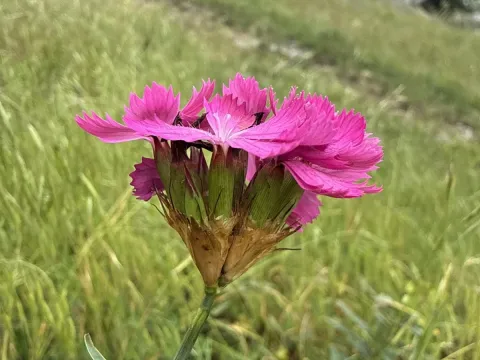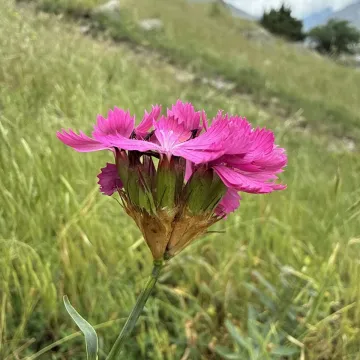
Clustered pink
Dianthus capitatus
Description
Clustered pink (lat. Dianthus capitatus) is a perennial herbaceous plant belonging to the Caryophyllaceae family. This species is distinguished by its unique habit, where small, vibrant flowers are densely packed into spherical or head-like clusters at the tips of the stems, making it a standout feature in any landscape.
The native distribution of this plant includes the southeastern parts of Europe, spanning regions such as the Balkans and neighboring areas. It is naturally adapted to rugged environments, frequently found in dry, rocky meadows, calcareous slopes, and exposed hillsides where sunlight is abundant and soil conditions can be quite harsh.
Botanically, Dianthus capitatus features slender, glaucous leaves and sturdy, upright stems typically reaching 30 to 60 cm in height. The inflorescence, as the name implies, is a tight cluster of pink or purple-hued flowers. Its root system is deep and efficient, allowing the plant to survive in conditions where moisture is intermittent.
In terms of cultivation, this species thrives in well-draining, slightly alkaline to neutral soil. It is highly resistant to drought and requires full sun to achieve optimal flowering density. Excessive watering or waterlogged soils are the primary factors that can lead to root rot and decrease the overall lifespan of the plant.
The primary horticultural use of clustered pink is in ornamental gardening, specifically in rock gardens, xeriscaping projects, and dry borders. Its ability to thrive in poor, rocky soils makes it an excellent candidate for low-maintenance sustainable garden designs where traditional flower varieties might struggle to survive.
- Excellent heat and drought tolerance.
- Requires full sun exposure.
- Suitable for rock gardens and xeriscapes.
Photo gallery