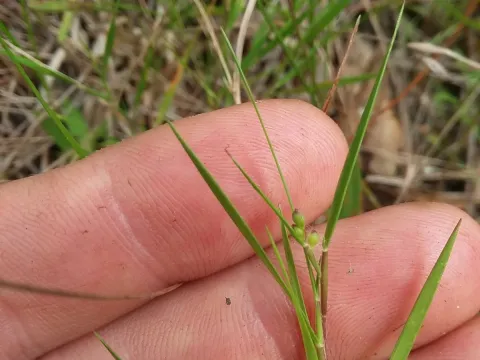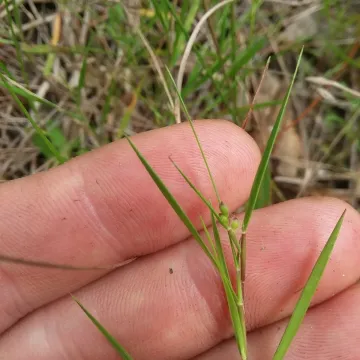
Dichanthelium aciculare
Dichanthelium aciculare
Description
Dichanthelium aciculare is a perennial grass species within the Poaceae family. Known for its resilience and adaptability, it is an essential component of native grasslands and prairie ecosystems. In an agricultural context, it is studied for its potential in sustainable forage production and land restoration projects, particularly in regions with sandy or acidic soil profiles.
The plant originates from North America, with a broad distribution spanning across the United States to Central America. Its ability to thrive in diverse habitats—ranging from open savannas to sparse woodlands—demonstrates a high level of ecological plasticity. This wide geographic range makes it a valuable species for ecological studies concerning native grass development.
Botanically, this species is characterized by its tufted growth habit and narrow, needle-like leaves, which are adaptations to arid conditions. It features a robust root system that stabilizes the soil and supports early spring green-up, allowing the plant to gain a head start in the growing season. The reproductive strategy is efficient, ensuring persistence in semi-natural environments.
Regarding cultivation requirements, Dichanthelium aciculare thrives in well-drained, nutrient-poor soils. It is particularly well-suited to sites that are too dry or acidic for more demanding agricultural crops. The grass requires minimal intervention in terms of chemical fertilizers, as it has evolved to maintain stability in low-fertility settings, provided there is adequate sun exposure.
The main areas of agricultural and environmental use include:
- Provision of hardy forage in extensive grazing systems.
- Soil conservation and erosion control on sloped terrains.
- Enhancement of native vegetation in biodiversity-focused land management.
- Low-maintenance ground cover for semi-natural restoration sites.
The plant is generally robust, but it can be susceptible to fungal pathogens like rust or leaf spots if humidity levels are consistently high. Common pests include various grass-specialized insects, such as aphids or stem borers. Management practices, such as controlled grazing or seasonal mowing, are often sufficient to maintain plant vigor and prevent the accumulation of old biomass that might harbor pests or diseases.
Photo gallery