Broad-leaved broom grass
Diheteropogon amplectens
Description
Broad-leaved broom grass (Diheteropogon amplectens) is a perennial grass species belonging to the Poaceae family. It is recognized in agricultural systems as a vital component of tropical and subtropical grasslands, serving as a reliable forage source for livestock production.
Native to Africa, this species is naturally distributed throughout savannas and wooded grasslands. It is highly valued for its natural adaptation to various environmental conditions, including regions characterized by seasonal water scarcity and fluctuating temperature regimes, making it a resilient option for land management.
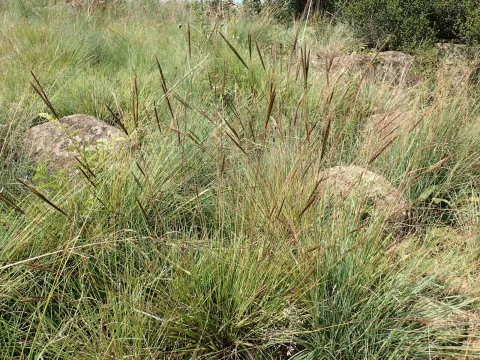
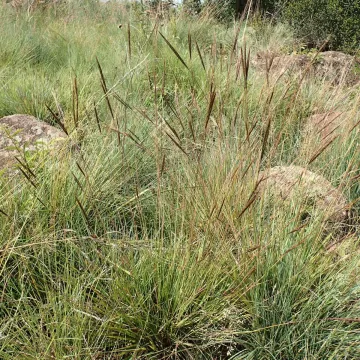
Botanically, it is a tufted, perennial bunchgrass reaching heights up to 1.5 meters. The leaves are typically broad and sheath the stem tightly, a characteristic that provides structural integrity. The plant possesses a robust root system that helps it survive in diverse soil profiles, including nutrient-poor substrates.
Successful cultivation requires well-drained soils and full sun exposure to maintain vigorous growth. Agronomic management revolves primarily around grazing pressure control, as moderate grazing cycles promote tiller production and prevent the plant from becoming overly lignified or woody during the late stages of its maturity.
The agricultural importance of this crop lies in its utility for extensive grazing systems and hay production. It offers a fair nutritional profile during the growing season, providing essential proteins and fibers for ruminants. Additionally, its capacity to stabilize soil makes it an effective species for land restoration and erosion control.
- Superior drought tolerance.
- Resilience in nutrient-poor soils.
- High regenerative capacity after defoliation.
- Excellent soil erosion control properties.
- Low input requirement for establishment.
Photo gallery