
Trailing African Daisy
Dimorphotheca fruticosa (L.) DC.
Description
Trailing African Daisy (Latin: Dimorphotheca fruticosa) is a perennial herbaceous plant or evergreen subshrub belonging to the Asteraceae family. Often confused with Osteospermum ecklonis in the trade, this species is highly valued for its spreading habit and profuse flowering, making it a staple in ornamental horticulture across mild-climate regions.
Native to South Africa, specifically coastal regions, this plant is naturally adapted to sandy soils and Mediterranean-like conditions. Its evolutionary history has endowed it with high heat tolerance and the ability to thrive in poor, well-draining soils. While it acts as a perennial in warmer climates, it is typically treated as an annual or protected plant in regions prone to heavy frost.
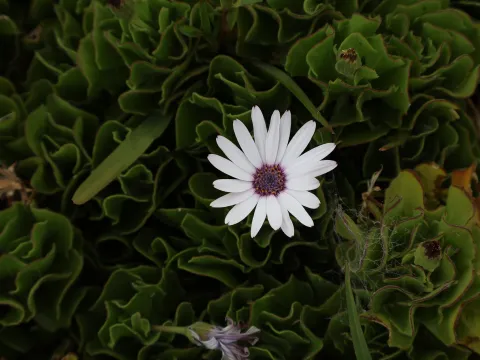
Botanically, the plant is characterized by its trailing or low-spreading stems that can reach 30–50 cm in height. The foliage is generally spatulate with serrated edges and may appear slightly fleshy. The flowers are daisy-like capitula with bright ray florets that close during the night or overcast weather, a phenomenon that helps protect the reproductive organs from damp conditions.
Regarding agrotechnical requirements, the Trailing African Daisy demands full sun exposure to maintain its compact growth habit and maximum bloom count. Soil preparation should focus on drainage; sandy-loam compositions are ideal. While the plant is drought-tolerant once established, supplemental irrigation during peak summer ensures constant flower production, though overwatering must be strictly avoided to prevent root rot.
The primary use of Dimorphotheca fruticosa is for ground cover, hanging baskets, and rock gardens. Pest management is crucial, as the succulent-like leaves attract aphids and spider mites. Regular deadheading of faded flowers is the most important cultural practice to ensure the plant continues to produce new blooms throughout the growing season.
- Prefers full sun and high light intensity.
- Excellent ground cover for arid landscapes.
- Sensitive to excessive soil moisture.
- Can be propagated by cuttings or seeds.
Photo gallery