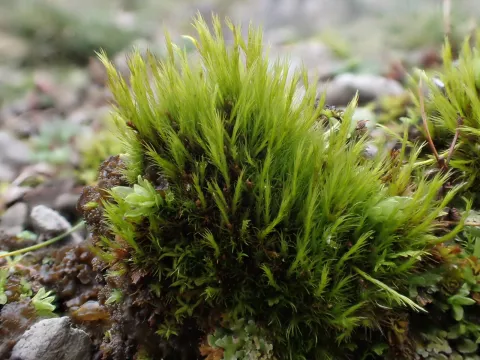
Bent-stemmed ditrichum
Ditrichum flexicaule
Description
Ditrichum flexicaule, commonly known as the bent-stemmed ditrichum, is a species of moss within the Ditrichaceae family. Unlike standard agricultural crops, this species serves as a critical component of soil-stabilizing vegetation in various ecosystems. It forms dense, mat-like colonies, typically exhibiting a yellowish-green hue, and thrives in challenging environmental conditions where other plants might struggle to establish.
The distribution of this moss is extensive across the Northern Hemisphere, spanning from Arctic and boreal regions to temperate zones and high-altitude mountainous areas. It is particularly characteristic of calcareous habitats. The plant is frequently found in environments with exposed mineral soils, rocky crevices, and sandy banks, which provide the alkaline or neutral conditions it requires to flourish.
Botanically, the plant is characterized by slender, flexuous stems and narrow, linear-lanceolate leaves with a strong midrib. These structural adaptations allow the moss to optimize moisture absorption from atmospheric sources. While sexual reproduction via spores occurs in specialized capsules (sporophytes) on elongated stalks, the species also employs asexual fragmentation, which allows for rapid colonization of nearby bare soil patches.
Regarding its ecological requirements, Ditrichum flexicaule demands stable, non-acidic soil conditions and sufficient light. It is highly sensitive to environmental stressors such as air pollution and heavy nitrogen loading. In its natural setting, the moss acts as a biological indicator; its presence often suggests a healthy, undisturbed soil substrate with low competition from invasive or highly dominant vascular plant species.
From a land management perspective, this moss is not a cultivated crop, yet it is of interest for ecological restoration projects. It plays a vital role in preventing topsoil erosion on steep slopes and rocky terrain. No specific pests or diseases typically threaten this species in the wild, though it is vulnerable to habitat loss and changes in soil chemistry, making it a focus for conservationists rather than traditional growers.
Photo gallery