Hoary whitlow-grass
Draba incana
Description
Hoary whitlow-grass (Draba incana) is a perennial herbaceous plant belonging to the Brassicaceae family. In the field of botany and plant science, it is recognized for its remarkable ability to colonize harsh, nutrient-poor environments where survival depends on extreme adaptation.
The native range of this species extends across northern regions, including Arctic and sub-Arctic zones, as well as high-altitude areas in mountain ranges. It is typically found in rocky meadows, on limestone outcrops, and in sandy, exposed habitats that require hardy plant species for stabilization.
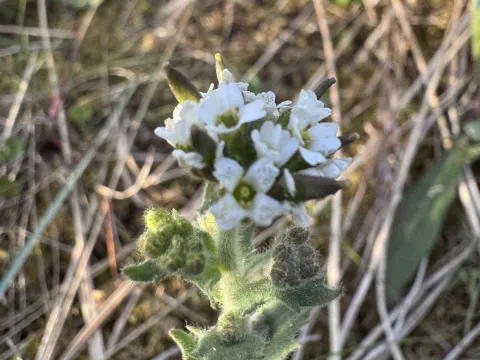
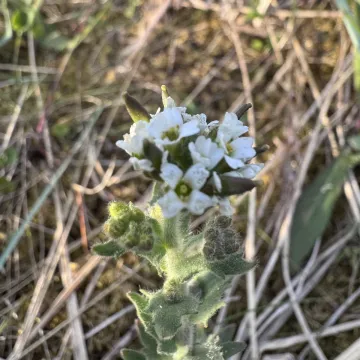
Botanically, the plant is characterized by a height ranging from 10 to 30 centimeters and a covering of dense, star-shaped hairs that provide a silvery-grey appearance, hence the common name. The leaves form a basal rosette, while the inflorescence consists of small, white, four-petaled flowers typical of its family, blooming in early summer.
Regarding climatic and soil requirements, hoary whitlow-grass is highly frost-tolerant and prefers well-drained, alkaline, or neutral soils. While it is not cultivated as a primary commercial crop, it is an essential component of local vegetation and is occasionally studied for its genetic resilience and tolerance to environmental stressors.
The primary agricultural interest in Draba incana lies in land management, particularly regarding the restoration of disturbed or erodible sites. Although not prone to major economic infestations, it can be susceptible to common Brassicaceae pests such as flea beetles, which may impact populations in dense clusters.
- Family: Brassicaceae
- Growth habit: Perennial herb
- Habitat: Rocky, sandy, open terrain
- Flowering time: Late spring to early summer
- Main usage: Habitat stabilization, ecological research
Photo gallery