Milky whitlow-grass
Draba lactea
Description
Milky whitlow-grass (lat. Draba lactea) is a perennial herbaceous plant belonging to the Brassicaceae family. While not a conventional agricultural crop, it is an essential object of study in botany and plant physiology, particularly regarding how plants adapt to cold, stressful Arctic and alpine environments.
The species has a circumpolar distribution, native to the high Arctic regions of the Northern Hemisphere, including Greenland, Canada, and Northern Eurasia. It thrives in open, rocky habitats, typically found in tundras, gravel bars, and areas with mineral-rich, well-drained soils that are exposed to direct sunlight.
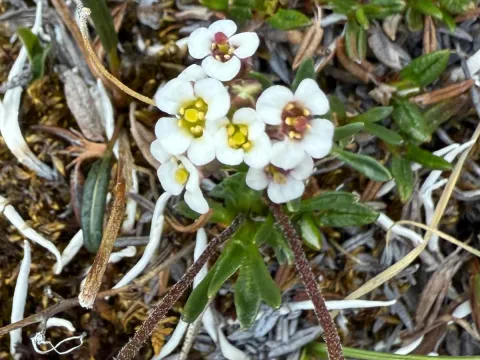
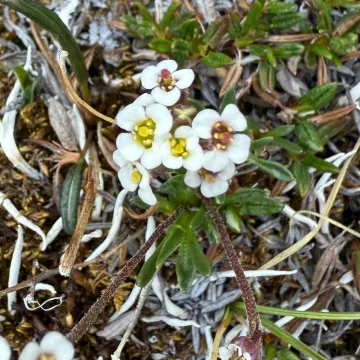
Botanically, Draba lactea is characterized by its small size, usually reaching no more than 15 cm in height. It forms a rosette of lanceolate leaves covered with fine hairs, which serves as a protective mechanism against dehydration. Its white flowers appear in small, terminal racemes, and the plant has evolved to complete its reproductive cycle within the very short Arctic growing season.
Cultivation requirements for this species are specific: it demands high light intensity, cool ambient temperatures, and an extremely well-drained substrate. It does not tolerate high humidity or waterlogged soil, which makes greenhouse cultivation difficult without precise climate control systems. It requires minimal fertilization, as it is adapted to nutrient-poor environments.
In terms of economic utility, this plant is primarily used as a genetic resource for research, helping scientists understand the mechanisms of frost tolerance and cold hardiness in Brassica crops. There are no major pests or diseases associated with this plant, as the harsh environmental conditions of its habitat act as a natural barrier to most agricultural pathogens.
Photo gallery